

Elections 2026: Municipality Discharges Sewage into the Vaal River
“I believe my cattle are falling ill from this water,” remarked Nosi Mane, a cattle herder from Jouberton, as he stood beside a sign expressing gratitude to individuals for “not polluting the environment.”
Mane, accompanied by his approximately two dozen cattle, was making his way to the shores of the Skoonspruit in Matlosana, North West, just beyond the Klerksdorp Wastewater Treatment Works (WWTW) located at the entrance of the township.
Over the 40 years he has resided here, Mane has observed the river undergoing a “transformation.”

Skoonspruit, which translates to “clean stream,” is ironically now a murky and foamy waterway that emits a foul odor.
Moreover, it serves as a tributary to the Vaal River, which provides fresh water to approximately one-third of South Africa’s population.
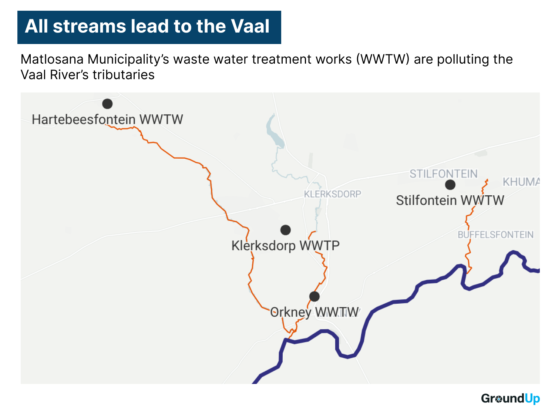
The City of Matlosana is currently under provincial administration, and its wastewater infrastructure has been deteriorating for years. Sewage spills and inadequately treated wastewater also contaminate the Jagspruit and Koekemoerspruit, which flow into the Vaal River.
In Kanana, located near Orkney, 15 km south of where we met Mane, we encountered Richard Ndlovu resting against a wall of a malfunctioning pump station.
Ndlovu gestured towards a manhole overflowing with raw sewage that has eroded a pathway towards the Skoonspruit, roughly 100 meters away. The Skoonspruit converges with the Vaal River approximately 5 km downstream.
“It has been this way for years,” Ndlovu stated.
He mentioned that his church group gathers near where the Jagspruit merges with the Skoonspruit every Sunday for baptisms and prayers, asserting that the water cleanses one as it is “protected by God.”
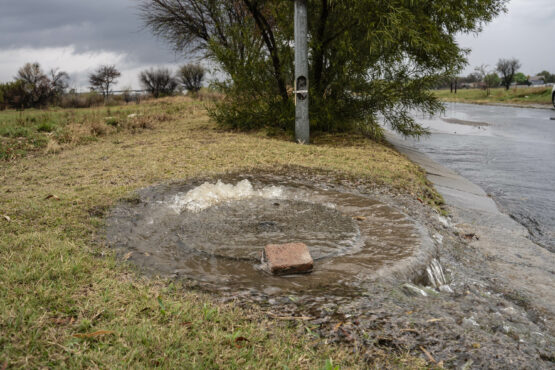
Raw sewage overflowing from a manhole into the streets of Klerksdorp, part of the City of Matlosana Local Municipality in the North West province.
The condition of the Skoonspruit endangers communities and farmers who rely on the water for irrigation. Sewage can introduce dangerous pathogens into the water, raising the risk of diseases like diarrhoea and cholera.
Furthermore, the organic matter and nutrients found in wastewater can decrease dissolved oxygen levels, leading to conditions where fish, frogs, and plants may not survive.
GroundUp conducted water quality tests in the Skoonspruit, downstream from the Klerksdorp and Orkney WWTWs, where inadequately treated and raw sewage enters the waterway. We employed citizen-science screening kits to test for coliform bacteria and E. coli.
ADVERTISEMENT
CONTINUE READING BELOW
The initial test was an AquaScreen, a rapid screening method for bacteria, including coliform bacteria, which naturally occur in the environment and in the intestines of warm-blooded animals.
According to the testing process, if the water turns black after 36 hours, this signifies the presence of coliform bacteria; a clear or yellow result is regarded as negative.
Our tests turned a dark, tar-like black remarkably fast.
Next, we conducted a Petrifilm test to screen for E. coli and coliform bacteria. Elevated levels of E. coli indicate faecal contamination and an increased risk of harm.
After 72 hours, blue spots on the Petrifilm indicate E. coli presence. For raw water, WaterCAN’s results guidance suggests that more than ten combined blue and red spots represent an unsafe result, particularly for recreational use.
The results demonstrated significant bacterial growth.
Ferrial Adam, executive director of WaterCAN, described the findings as “horrifying,” particularly considering that some individuals are utilizing the water for agricultural and recreational purposes.
“We are aware that throughout the country, pollutants such as sewage are contaminating our waterways. This is destroying our river ecosystems, impacting livelihoods and posing a threat to public health,” she stated.
Adam urged the City of Matlosana to conduct an urgent bacteria assessment of the river and make the results public.
Read: Raw sewage is flowing in nearly every metro
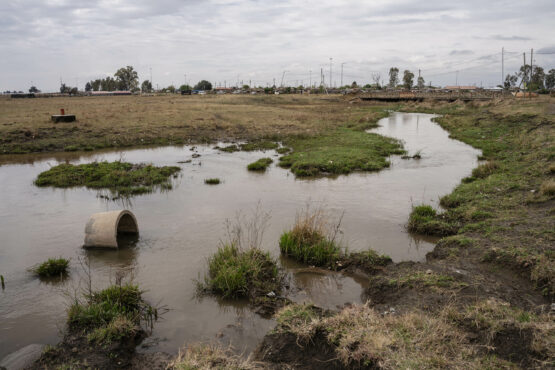
The Koekemoerspruit flowing through Khuma township near Stilfontein in the North West province.
A much larger crisis
The Department of Water and Sanitation (DWS), along with the Auditor-General (AG), parliament, and civil society, have recognized a broader sanitation crisis in Matlosana, resulting from years of aging systems, lack of qualified personnel, insufficient budget allocations for maintenance and upgrades, vandalism, and inadequate revenue.
ADVERTISEMENT:
CONTINUE READING BELOW
DWS frequently conducts audits on WWTWs across the country, evaluating water authorities based on operational capacity, environmental performance, financial management, technical skills, and compliance with effluent and sludge standards in its Green Drop report.
A score of 90% or higher is considered excellent, while scores below 31% are deemed critical and in need of intervention.
In its 2025 report, Matlosana received an overall score of 11.9% for its sewage management.
Every WWTW within the region had fallen to a critical state, with Klerksdorp receiving a mere 8.4%, Orkney 10.7%, Stilfontein 16.5%, and Hartebeesfontein 23.2%. The report indicated issues such as damaged, neglected, or vandalized infrastructure.
Of Matlosana’s total designed capacity of 77 million litres per day, 40 million litres is currently unusable.
The Klerksdorp WWTW facility is, as of now, non-operational.
During a May 2026 oversight visit by the National Council of Provinces (NCOP), delegate Dennis Ryder described the plant as “a crime scene.”
Members of the NCOP expressed concerns over the “escalating river pollution” stemming from the facility remaining offline for over three years.
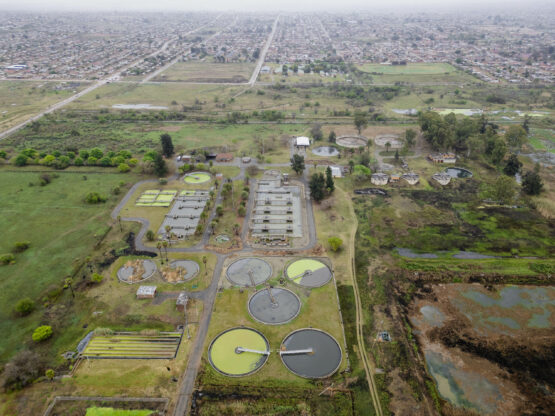
The Klerksdorp Wastewater Treatment Plant, located near Jouberton township, is primarily non-functional, which causes raw sewage to flow into the Skoonspruit and Vaal River systems.
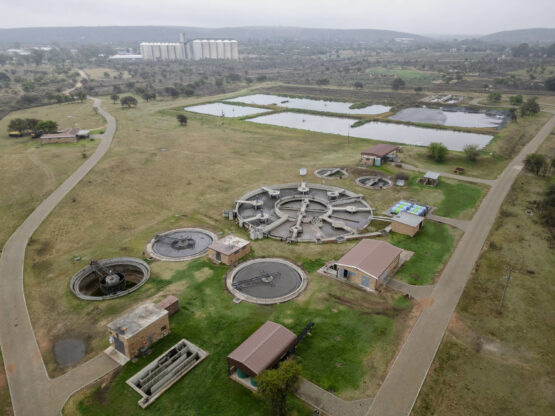
The Hartebeesfontein Wastewater Treatment Works in Hartebeesfontein, North West province, is non-operational.
At the Hartebeesfontein facility, which has been out of service since December 2025, NCOP delegates raised alarms about untreated sewage flowing into the Vaal River through the Jagspruit.
A recent inspection of the Jagspruit revealed continued pollution, characterized by foamy water and a strong methane-like odor.
In 2022, the AG noted a material irregularity regarding Orkney’s ongoing pollution of the Skoonspruit, referring the issue to the DWS in 2025 for investigation due to the “significant harm to the communities exposed and reliant on the contaminated water resources.”
Read: Mogale City still polluting Cradle of Mankind
The South African Human Rights Commission (SAHRC) found during its 2025 investigation that Matlosana had “failed” to address reported sewer spillage problems, violating residents’ constitutional rights.
The SAHRC indicated that the municipality had not been able to provide sustainable services or take reasonable actions to prevent or rectify pollution, breaching both the Constitution and the National Environmental Management Act.
ADVERTISEMENT:
CONTINUE READING BELOW
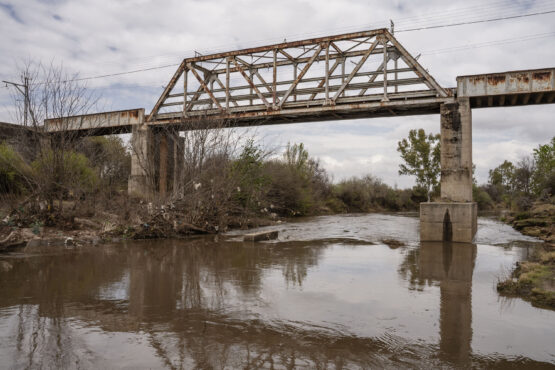
Poorly treated sewage flowing straight into the Skoonspruit from the Orkney Waste Water Treatment Plant.
Deputy Minister of Water and Sanitation, Jack Bloom, expressed frustration to GroundUp regarding the “construction of high-quality facilities that municipalities fail to maintain.”
The City’s annual report for 2024/25 indicates it utilized just R17.4 million of its R26.8 million budget for sanitation repairs and maintenance.
DWS testing showed that microbiological compliance in wastewater averaged 35% between January and June 2026, signifying a failure to properly treat and eliminate pathogens.
Bloom is advocating for the prompt passage of the Water Services Amendment Bill, which Water and Sanitation Minister Pemmy Majodina introduced in October 2025 and which began its public hearings in August 2026.
He highlighted provisions that would shift the responsibility for mismanagement “away from ratepayers and onto those accountable.”
Among the key provisions are new criminal offenses for non-compliance, with potential penalties of up to R10 million in fines, 10 years in prison, or both.
Officials may be held personally liable for offenses committed by their municipality if they were aware of the issue and did not take reasonable preventive measures.
The City of Matlosana had not responded by the time of publication. Any comments will be added.
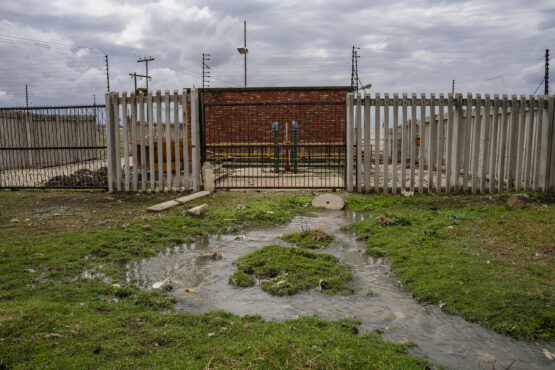
An overflowing pump station near Orkney contaminates the Skoonspruit.
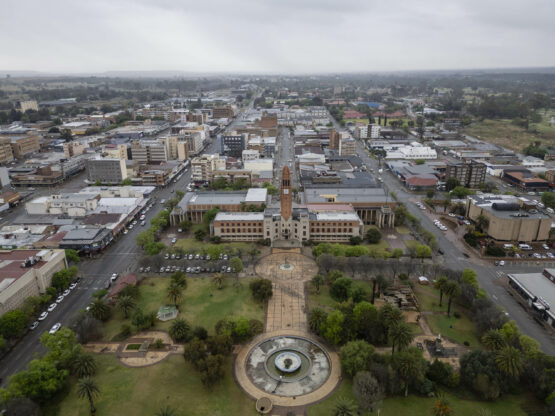
The council building for the City of Matlosana Local Municipality in Klerksdorp, North West province.
This article was originally published here.
© 2026 GroundUp.