

Lavazza CEO Aims for US and China Expansion to Compete with Major Coffee Brands
As the descendants of Luigi prepared to transition their century-old Italian coffee roasting business to its first external manager, they treated Antonio Baravalle to dinner, where they outlined their expectations.
The family anticipated that “sooner or later, consolidation in the industry would commence,” as recalled by the Lavazza Group CEO. His responsibility was to ensure that when they returned to the restaurant with competitors, the Lavazza heirs would be “perusing the menu rather than being featured on it.”
Avoiding the latter scenario necessitated growth, particularly in a rapidly changing market in order to compete with major players like Nestlé SA and Starbucks Corp.
Upon taking charge in 2011, Lavazza generated around 70% of its revenue from Italy, rendering it both undersized and heavily reliant on its domestic market. Fast forward fifteen years, and the group has completed a significant transformation, expanding notably in China and the US.
“Today, over 75% of our turnover is derived from outside the country,” Baravalle stated during an interview at Bloomberg’s offices in Milan.
Read: Italy’s Illy coffee garners attention from JAB and Nestlé
The journey is ongoing, with the privately-owned Lavazza aiming for €5 billion ($5.95 billion) in annual revenue within a few years, following a 16% increase to €3.9 billion by 2025. In North America, the target to double revenue to $1 billion by 2029 is progressing well, concentrating on e-commerce and retail.
“We are investing heavily in the USA,” remarked the 61-year-old executive.
Luigi Lavazza, the great-grandfather of the current generation of owners, opened his first shop in Turin in 1895. He dedicated himself to studying the origins and characteristics of various coffee beans, as well as how to blend them to meet customer preferences.
The company flourished alongside a dynamic Italian coffee industry as coffee bars evolved into local gathering spots during the early 20th century. The booming economy of the late 1950s prompted the family to shift towards industrial-scale production.
ADVERTISEMENT
CONTINUE READING BELOW
Decades later, Starbucks popularized gourmet coffee worldwide, a revolution further propelled by Nespresso machines for home consumption. Each development pushed others to adapt. Now, drinks like matcha and the Instagram-friendly ube, made from purple yams, are gaining traction.
“Lavazza boasts a rich heritage and a distinctive branding position in the market,” said Jeffrey Young, head of London consultancy Allegra Strategies. However, one of its primary challenges is “the rapid market changes and the need to adapt to modern coffee styles.”
Read: Coffee prices projected to keep rising into 2025, states Lavazza
China serves as a prime example, with Shanghai housing the highest number of coffee shops per capita of any major city globally, according to Baravalle.
In 2020, Lavazza established a joint venture with Yum China Holdings Inc, the mainland licensee for KFC, Pizza Hut, and Taco Bell. New products are introduced every two weeks to align with fast-evolving trends.
A recent visit to a Lavazza café in central Shanghai highlighted a seasonal camellia-flavored buffalo-milk latte priced at 36 yuan ($5.27).
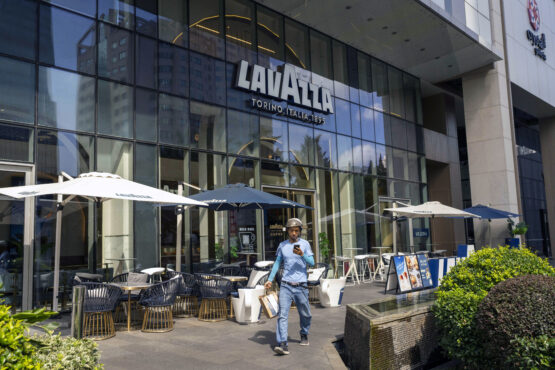
A Lavazza coffee shop, operated by Yum China Holdings Inc, in Shanghai. Image: Raul Ariano/Bloomberg
“I cherish innovation,” Baravalle remarked. “It ensures that the category progresses and doesn’t devolve into a commodity.”
Buffalo milk beverages have emerged as best-sellers for Lavazza in China, receiving acclaim on social media for their rich sweetness and nutritional benefits.
ADVERTISEMENT:
CONTINUE READING BELOW
Lavazza intends to have 200 shops operating by year-end, a rise from the current 145, Baravalle stated.
The initial aim of achieving 1,000 coffee outlets by 2025 has been delayed due to the global Covid-19 pandemic.
It’s still a long-term objective, according to Baravalle. Nevertheless, he expresses satisfaction with the Yum China partnership. The stores, adorned in a refined blue-and-white palette, reflect a light interpretation of Italian luxury.
Read: China’s coffee unicorn is investing millions to surpass Starbucks
He believes these outlets are crucial for elevating Lavazza’s profile as a premium option for home consumers. “In China, the only way to enhance brand equity is through coffee shops,” he explained.
Celebrating Success
Conversely, the US presents a different scenario—a crowded yet lucrative market with the potential for higher margins compared to Europe. Doubling Lavazza’s market share from 1%-2% would warrant “champagne celebrations,” Baravalle noted.
The strategy encompasses investments in marketing and infrastructure, ensuring Lavazza can manage stock rotations at significant retailers, Baravalle added.
The company is enhancing the production capacity of its West Chester, Pennsylvania plant, which accounts for 50% of Lavazza coffee sold in the US.
Last year, North America’s revenue surged by 27%—which also includes Canada, where Lavazza owns Kicking Horse coffee—primarily through retail and e-commerce channels.
ADVERTISEMENT:
CONTINUE READING BELOW
Despite the revenue increase expected in 2025, coffee bean price volatility and US tariffs have impacted profitability, leading to a 0.5 percentage point narrowing in earnings before interest, taxes, depreciation, and amortization margin to 8.8%.
Although prices have decreased, they remain 300% above 2021 levels, Baravalle stated. An enhanced US presence will help mitigate tariffs and neutralize the currency effects associated with dollar-priced coffee purchases, which total $1.6 billion annually.
Read: Rising coffee prices are altering how and where people acquire caffeine
The company’s size also improves its access to credit markets, which last month secured a €900 million five-year loan facility with several banks.
“I was taught to seek support when times are good, not when challenges arise,” remarked Baravalle, a marine biologist who previously worked with Sergio Marchionne at Fiat Chrysler and led Italian book publisher Mondadori.
Baravalle dismissed the idea of an initial public offering and stated that Lavazza has no intention of pursuing any transformational deals. To date, the Lavazza family has consistently declined offers from potential buyers.
Primarily, the funds are intended to ensure readiness for opportunities as they arise, Baravalle explained. When he joined in 2011, the company stood at a crossroads—either the largest of the small or the smallest of the large coffee roasters.
At this juncture, he asserted, Lavazza is “capable of crossing the river on its own.”
© 2026 Bloomberg