
$1.3 Billion Windfall: SA Rugby Officials Provide Candid Assessment of McKenzie’s World Cup Goals
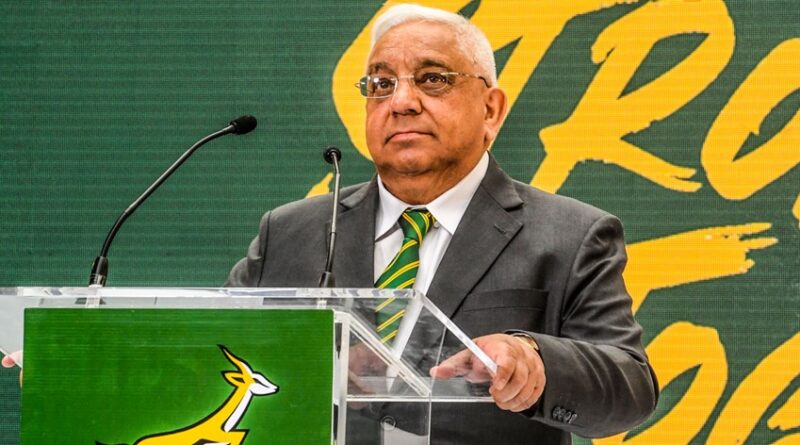
In light of South African Minister of Sport Gayton McKenzie’s assertion that he “will not rest” until the Rugby World Cup is once again held in South Africa, SA Rugby president Mark Alexander and CEO Rian Oberholzer have taken a cautious stance, highlighting the considerable financial and infrastructural hurdles involved in hosting this esteemed tournament.
Alexander, who was re-elected for a final term unopposed during the organization’s AGM at the Southern Sun Cape Sun on Thursday, recognized McKenzie’s passion but pointed out that SA Rugby has yet to initiate discussions regarding a potential future hosting opportunity.
The Springboks, champions of the Rugby World Cup four times, last hosted the event in 1995, famously clinching the trophy on home ground during their debut.
Since that triumph, South Africa has made multiple attempts to host the event again, most notably bidding for the 2023 Rugby World Cup, which was ultimately awarded to France despite South Africa being initially favored.
McKenzie recently indicated that conversations with possible sponsors have started in order to raise approximately R3 billion for hosting expenses.

However, both Alexander and Oberholzer stressed that the financial demands are significantly elevated when considering global benchmarks and the commercial expectations established by World Rugby.
“He is the Minister of Sport, and he has every right to share his thoughts,” Alexander remarked.
“As SA Rugby, we must assess our willingness to host a World Cup. Given the various implications and financial resources needed, we haven’t yet engaged in those discussions.”
He further noted that South Africa opted not to pursue additional bids because the next valid opportunity might not arise until 2035.
“The venues will need improvement, and extensive work is required before hosting an event of this scale,” Alexander explained.
“We value the minister’s sentiments; he is free to express them, but as an organization, we haven’t seriously considered this yet.”
Oberholzer echoed this viewpoint, emphasizing that hosting a Rugby World Cup involves unique challenges compared to other international sports events due to the financial framework mandated by World Rugby.
“The minister is passionate about bringing significant international events to South Africa, which is admirable,” Oberholzer stated.
“Nonetheless, we must understand the realities involved in hosting a World Cup here; it differs markedly from other sports.”
A chief concern raised by the SA Rugby CEO is the condition of the nation’s stadium infrastructure. According to Oberholzer, considerable funding would be required to upgrade venues to a world-class standard.
“In South Africa, preventive maintenance for most stadiums is lacking,” he pointed out.
“A substantial investment would be necessary to elevate the stadiums to international standards—and we also need to factor in the broader infrastructure that requires attention.”
Oberholzer also highlighted that SA Rugby does not own the commercial rights to the tournament, which restricts the union’s ability to lessen costs through sponsorship agreements.
“We don’t control the commercial rights, so we can’t simply bring sponsors on board to alleviate the event’s expenses,” he clarified.
“For us, the only revenue stream we receive from a World Cup is from ticket sales, while the majority of the tournament’s costs still need to be covered.”
The financial difficulties multiply when compared to the potential income from hosting the event in Europe or in emerging markets like the United States.
“You must also compare the revenue that World Rugby can generate in South Africa to what can be achieved in Europe,” Oberholzer remarked.
“These decisions are made by World Rugby, as the tournament serves as their primary income source, crucial for supporting all 90 member unions.”
According to Oberholzer, any future bid from South Africa would need to ensure substantial profits for World Rugby before it could be taken seriously.
“If we can secure the necessary government support to guarantee a $700 million profit for World Rugby, we can begin discussions—remember, those are profits they need to see.”
He also mentioned that the 2031 Rugby World Cup in the United States is projected to generate around $1 billion in profit for World Rugby.
“We would need to convince World Rugby that they could realize a $1.3 billion profit that we could support in South Africa,” he elaborated.
“Only then can we evaluate whether it would be advantageous for us.”
Alexander concluded by stressing that hosting such a large-scale event requires coordination and funding from various government departments, not just the sports ministry.
“Organizing an event of this magnitude affects departments like security and home affairs, which would need their own budgets; it’s not merely about coordinating rugby matches,” he explained.
Despite the numerous logistical and financial challenges, both leaders of SA Rugby appreciated McKenzie’s zeal for bringing elite international sport back to South Africa.
“We acknowledge the minister’s passion and value his input,” Alexander concluded.
“We would be eager to collaborate with him.”
