

Hidden Risks in the Index and Opportunities Ahead
For over a decade, passive investing has influenced global asset management. The appeal of low costs, simplicity, and robust performance has driven the popularity of index-tracking strategies. However, this success comes with a more intricate picture, shaped by concentration risk and the opportunity cost of limited exposure to emerging growth areas.
As markets shift, these risks become evident, leaving investors in index strategies vulnerable to past winners. In these times, active management presents a clear advantage with its ability to selectively allocate, manage risks, and seize new opportunities as they arise.
Read/listen:
The war effect: The real story versus the market story
Outperforming the index in 2026
Typically, passive strategies track indices that are weighted by market capitalization, meaning larger companies hold bigger weightings in the index.
Strong share-price performance automatically amplifies that exposure. The U.S. illustrates this clearly, with a small group of technology giants—the Magnificent 7: Alphabet, Amazon, Apple, Meta Platforms, Microsoft, Nvidia, and Tesla—accounting for a significant share of market returns.
Their dominance stems from genuine innovation, particularly in AI and digital infrastructure, yet this reliance on a narrow set of companies and themes makes index performance increasingly vulnerable.
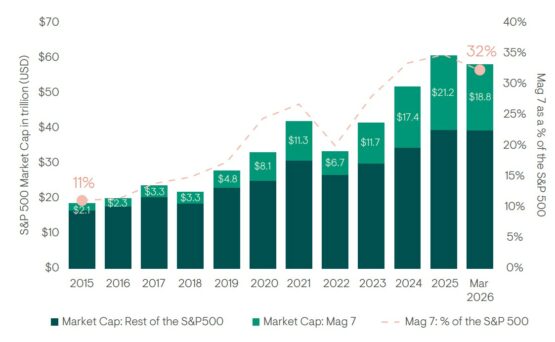
Source: Bloomberg as of 31 March 2026. Based on research from Defiant Capital Group.
ADVERTISEMENT
CONTINUE READING BELOW
A similar trend is seen in South Africa. Following years of lackluster performance, the equity market has rebounded, yet much of this uptick is confined to a few sectors, particularly precious metals firms benefiting from rising commodity prices.
Among the top 25 firms in the FTSE/JSE All Share Index (Alsi), which constitute approximately 75% of the index, resources surged from 22% to 31.3% over the past two years.
More notably, 25.6% of that 31.3% stems from just seven precious metals companies. Gold Fields and AngloGold Ashanti alone accounted for 14.6% of the entire index by the end of March 2026, up from 5.5% in 2023.
While concentration isn’t inherently problematic if leading companies continue to perform, it does mean index-tracking portfolios are increasingly reliant on a select few businesses. When leadership evolves, as it inevitably does, the impact on passive-heavy portfolios can be pronounced.
Watch: ‘The risks and opportunities you can’t overlook’ – Ninety One’s Hendrik du Toit
The global economy has also experienced substantial structural changes. Technological disruption, geopolitical shifts, and evolving supply chains are transforming industries and reconfiguring competitive advantages. Innovations in artificial intelligence and automation are speeding these changes, while both nations and businesses rethink their trade relations, energy security, and strategic priorities.
Supply chains are prioritizing regional resilience over mere cost efficiency. These dynamics explain much of the current market leadership while also setting the stage for new winners and themes to surface.
ADVERTISEMENT:
CONTINUE READING BELOW
This is significant for investors. Passive strategies often reinforce exposure to established leaders, while active managers can pivot to new opportunities, react to risks, and reconfigure portfolios as market leadership shifts.
Active vs passive debate
The conversation surrounding active versus passive investing is frequently framed as a binary choice; however, in practice, the best portfolios usually incorporate both. Passive strategies provide efficient access to wide market exposure and can serve as a solid foundation, while active strategies enhance the potential for better returns, risk management, and dynamic capital allocation.
The critical question is not whether passive investing is effective—it is—but rather how much passive exposure is suitable in the current landscape and when should one consider increasing allocations to active strategies.
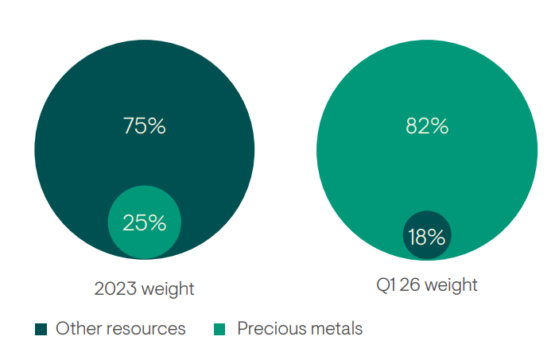
Source: Bloomberg, as of 31 March 2026. Based on the top 25 stocks listed on the FTSE/JSE Alsi.
Current market dynamics suggest that the opportunity landscape for active investors is broadening. The concentration in major equity indices has grown, making returns increasingly reliant on a relatively small group of companies.
Moreover, divergence in valuations and growth prospects across sectors and businesses has also widened, leading to greater variability in potential outcomes.
ADVERTISEMENT:
CONTINUE READING BELOW
Simultaneously, the global economy is adapting to technological upheaval, geopolitical shifts, and changing supply chains.
Periods characterized by concentration, dispersion, and structural transformation often favor investors capable of assessing companies independently and allocating capital judiciously. Passive investing remains an effective tool for obtaining broad market access, but it also mirrors the market’s current state, highlighting its concentrations, imbalances, and momentum.
Read:
Investors seek hedges as conflict disrupts long-standing strategies
A fund charging 6% fees? [Dec 2025]
In a rapidly changing environment, relying solely on index exposure risks tying portfolios too closely to former winners. Increasing exposure to disciplined, research-driven active strategies can mitigate concentration risk, reveal emerging opportunities, and adapt as market leadership evolves.
We believe that the next phase of the cycle calls for a conscious shift towards active management, coupled with the flexibility to handle risks more effectively and seize new opportunities as they arise. Stay tuned for the next installment in this series, where we will delve into the key assumptions and misconceptions about active and passive investing.
Siobhan Simpson is Head of SA Unit Trusts at Ninety One.