
27 Years of Sewage: The Stinky Neighbor of Kruger Park
The Auditor-General is looking into an escalating sewage crisis in Phalaborwa, adjacent to the Kruger National Park.
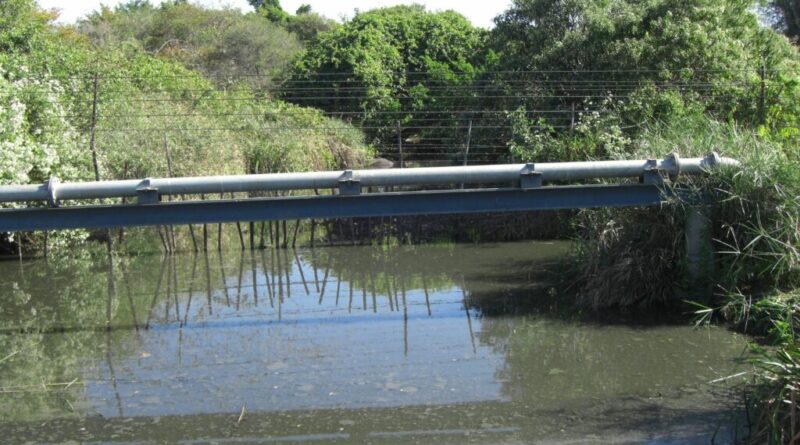
GroundUp reported in March that raw sewage has been contaminating the park for a minimum of 27 years via the Tshutsi and Ga-Selati rivers due to Phalaborwa’s deteriorating infrastructure. Sewage discharges frequently occur on the streets of Phalaborwa.
ADVERTISEMENT
CONTINUE READING BELOW
The Blue Scorpions, part of the Department of Water and Sanitation, have conducted an investigation into the matter following criminal charges filed in 2022 by the Let’s Change Ba-Phalaborwa Community Forum (LCBP). However, their findings seem to be stagnant.
The department stated in March that it was waiting for a decision from the National Prosecuting Authority (NPA). However, NPA spokesperson Mashudu Malabi informed us in July that the investigation by SAPS is still ongoing and “when the case is enrolled we will be able to comment.” SAPS did not provide any remarks.
Trevor van Rooyen, vice-chairperson of the LCBP, noted that, as far as they know, the NPA is waiting for additional information from the Department of Water and Sanitation. Yet, department spokesperson Wisane Mavasa asserted this week: “The department has submitted the matter to law enforcement as stated before. We have no authority over their proceedings.”
Stench looms over new tourist facilities
Last week, we returned to Phalaborwa to join representatives from the Auditor-General’s office on a tour of the area’s sewage network alongside members of the Let’s Change Ba-Phalaborwa Community Forum.
Within the park, we visited a site where new backpacker accommodation for the Phalaborwa Wildlife Activity Hub is under construction, expected to be completed by 1 November. However, the location is only a few meters away from the Tshutsi River, which is tainted with sewage.
A SANParks representative at the Kruger National Park mentioned to GroundUp that the sewage situation may cause delays in the project.
Outside the park, there are five emergency dams intended to hold wastewater in case the municipal treatment facilities fail. Ideally, they should be empty, but one dam has become a permanent reservoir of sewage, with a herd of hippopotamuses residing there.
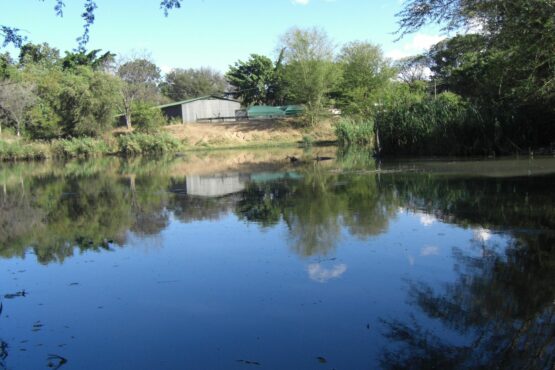
Five emergency dams should be empty, but this one is always full of sewage and wastewater due to pump malfunctions.
Deteriorating infrastructure
We examined three sewer pump stations in Phalaborwa town that were malfunctioning, despite recent refurbishments.
In the streets of Phalaborwa, raw sewage seeps from manholes, creating swamp-like areas where stagnant sewage emits a repugnant smell.
Mopani District Municipality spokesperson Odas Ngobeni explained to GroundUp that the pump stations are frequently vandalized and cables stolen. They plan to enhance security at the affected pump stations.
Ngobeni also noted that residents in certain villages have illegally connected their toilets to the main sewer line, leading to blockages.
The municipality has replaced the damaged and stolen cables and repaired the stations, which are currently functional, stated Ngobeni.
However, van Rooyen from the LCBP contends that the stations are still not operating properly despite the repairs. This ongoing issue has persisted for many years. The forum has requested municipal action “hundreds of times” over the last 15 years, he affirmed.
Van Rooyen pointed out that the Molengraaf pump station, for instance, has not functioned properly for at least five years. “The evidence is evident as the pump station is situated in the middle of a sewage swamp, with sewage flowing down Molengraaf Street,” he stated.
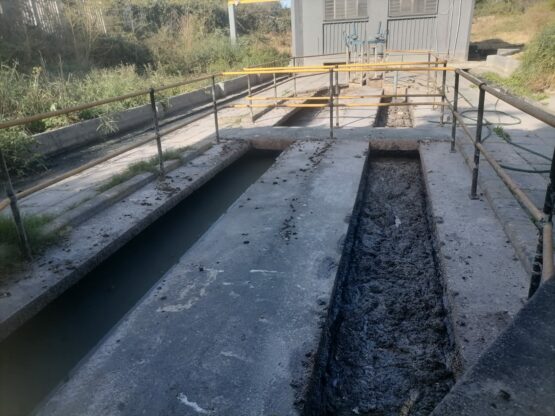
The primary sewer system in Phalaborwa town is not functioning optimally, leading to drying sewage.
Local businesses struggle
GroundUp visited several peripheral villages near Phalaborwa town, including Makhushane, Mapikiri, Mandela, and Hanivela.
ADVERTISEMENT:
CONTINUE READING BELOW
Residents voiced complaints about a persistent foul odor caused by sewage streaming from manholes. Community leader Edwin Malatji stated that the community has interacted with the municipality, but no improvements have been made. The sewage issue has only worsened, he claims.
Small business owners in Mandela Village reported that they are on the brink of shutting down due to the smell.
“I’ve stopped preparing fresh chips because very few customers are showing up. They flee from the stench of the raw sewage,” remarked spaza shop owner Ngwako Monyela, who has had a continual stream of sewage outside his store for over five months.
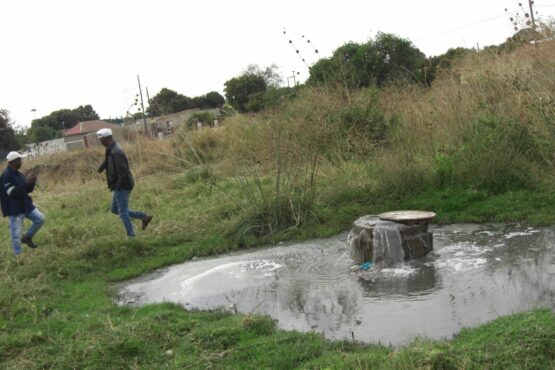
A manhole in Mandela village that is nearly always overflowing with sewage.
Municipality vows to invest
Ngobeni mentioned that the municipality has cleaned the 4.8 km sewer network in the area and has replaced some manholes in town.
However, van Rooyen expressed skepticism regarding this assertion. The numerous overflowing manholes and sewage leaks reinforce his doubts.
Ngobeni confirmed that the municipality plans to renovate the remainder of the sewage system in Phalaborwa and nearby areas this year. A total of R25 million, amounting to 10% of the Municipal Infrastructure Grant funding for the 2025/26 fiscal year, has been allocated for this initiative.
“The financial year commenced on 1 July, and we are still in the process of appointing contractors, but these projects are prioritized,” stated Ngobeni.
Van Rooyen highlighted that in previous years, the municipality has made similar assurances regarding investments in the sewage system, yet nothing has materialized.
The municipality’s annual reports for 2022/23 and 2023/24 reveal extensive water pollution across the region and significant underachievement in its sanitation delivery program.
The municipality received qualified audit opinions in both 2022/23 and 2023/24, indicating substantial errors in the financial statements, preventing the auditor general from affirming their accuracy.
Prior to 2022, the municipality experienced several years of disclaimed audit opinions, meaning the financial records were in such disarray that the auditor-general could not provide an opinion.
Ongoing investigations into irregular expenditures and corruption have been conducted for over a decade.
© 2025 GroundUp. This article was first published here.
Follow Moneyweb’s comprehensive finance and business news on WhatsApp here.