
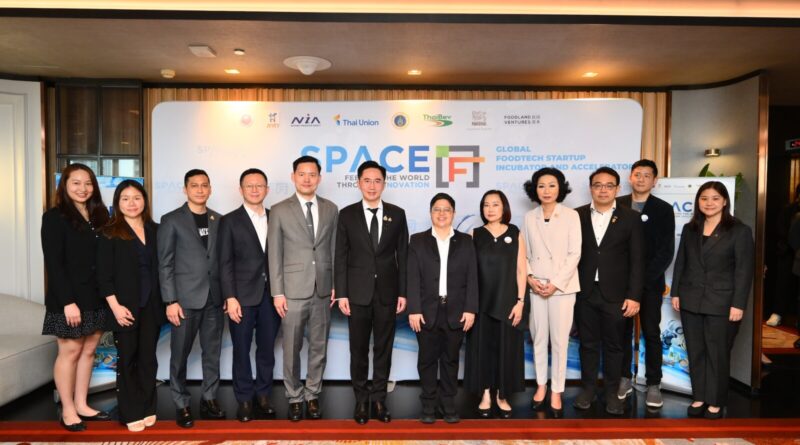
MHESI Teams Up with Partners to Launch SPACE-F Batch 7, Elevating Thai FoodTech on the Global Stage and Promoting the Wellness Economy as a New Economic Driver

SPACE-F Batch 7
Prof. Dr. Yodchanan discussed advancing “SPACE-F Batch 7” to a policy level, emphasizing the importance of raising awareness. He stated that MHESI intends to showcase food innovation products from this batch at the forthcoming Cabinet meeting, allowing the Prime Minister to sample them and increasing recognition of FoodTech as the nation’s promising future. These products will be presented to the Cabinet within two weeks.
– Advertisement –
Focused on integrating technology with “Thai taste,” Prof. Dr. Yodchanan highlighted the importance of maintaining the “Nice taste of Thailand,” regardless of technological advancements. He referenced a “high-tech omelet” he had previously tasted, noting that improvements are needed to align the flavor closer to that of an authentic Thai omelet, ensuring consumer acceptance.
The MHESI Minister further clarified that this year’s food innovation efforts will leverage the Wellness Economy as a New Growth Engine. This initiative is broad, extending beyond food to incorporate AI, ICT, and software, with the aim of positioning Thailand as a global Wellness Tourism Hub, supported by the BOI in facilitating investment opportunities.
Prof. Dr. Yodchanan also mentioned that startups will be encouraged to harness Thailand’s rich biodiversity and geographical indicators (GI) to replace imported raw materials, thus reducing costs and cultivating a distinctive identity.
“Connecting the ‘Thinker’ with the ‘Doer’ is pivotal; this program emphasizes the collaboration between startups and established corporations, enabling startups in the Accelerator group to secure Series A or B funding while the Incubator group acquires business and pitching skills from more experienced peers to navigate business challenges. In the context of global wartime conditions, Food Security and Nutrition Security are critical. This initiative presents a platform for startups to innovate solutions to global challenges, with governmental support through SPACE-F to develop new services and products,” stated the MHESI Minister.
“SPACE-F Batch 7” boasts 20 participating startups from 10 different countries, concentrating on the Proof of Concept (POC) strategy to facilitate tangible growth toward international commercialization.
Dr. Krithpaka Boonfueng, Executive Director of the National Innovation Agency (NIA), affirmed that NIA’s goal is to enhance the capabilities of startups and innovative entrepreneurs to navigate business crises and achieve commercial success. Over the past six years, the SPACE-F program has solidified its role as a regional food innovation hub by accelerating and incubating over 100 startups from 18 countries, cumulatively generating over 5.1 billion THB in funding. For the SPACE-F Year 7 program, this marks a significant leap with a record 204 applicants, increasing from 156 in Cohort 6 and 148 in Cohort 2, reflecting growing global confidence in the program’s potential. Additionally, the program has broadened its international scope, drawing applicants from 57 countries, up from 34 in the previous cohort, verifying that SPACE-F serves as a truly global platform for harnessing food innovation.
– Advertisement –
The SPACE-F program is key in fostering a robust and comprehensive foodtech startup ecosystem by systematically connecting knowledge, technology, and the industrial sector. It provides startups with opportunities to co-develop and trial real products (Proof of Concept: POC) with major corporate partners and access to expert resources and world-class infrastructure. This includes evaluating protein innovations for appearance, freshness, and taste with Thai Union; developing contemporary health and nutrition solutions with ThaiBev and Nestlé; leveraging advanced research laboratories from Mahidol University; and enhancing fundraising abilities through Foodland Ventures, which mitigates business risks and maximizes the chances of commercialization. For SPACE-F Year 7, the program will focus on advancing startup growth through two main tracks: the Incubator Program, centered on establishing business foundations and converting prototypes into market-ready products, and the Accelerator Program, aimed at accelerating business growth through strategic partnerships and investor connections. It will encompass 7 key areas within the food industry: 1) Personalized Nutrition, 2) Future Protein, 3) Circular Food Systems, 4) Smart Manufacturing, 5) Sustainable Production, 6) Food Safety, and 7) Novel Consumer Experience, to cultivate high-potential startups adept at developing quality new products that align with market demands, ready for sustainable competition on a global scale.
Ms. Sirichit Jiraruangkiat, Senior Director – Group Innovation at Thai Union Group PCL, expressed, “As a co-founding partner of the SPACE-F program, Thai Union Group PCL continues to enhance the development of Thailand’s foodtech startup ecosystem. Our goal is to stimulate significant growth by promoting innovation development and testing at the industrial level, particularly through the Proof of Concept (POC) process, to uplift future protein product standards to compete globally. Thai Union emphasizes modern food production and preservation technologies, addressing aspects from product quality and freshness to aesthetic appeal and sensory research, creating textures and flavors aligning with global consumer demands. Concurrently, the SPACE-F program upholds a ‘No Equity Taken’ principle, enabling startups to retain full ownership of their innovations, stay agile, and grow sustainably in the long term.”
Assoc. Prof. Dr. Pasit Pakawatpanurut, Deputy Dean for Research and Innovation, Faculty of Science, Mahidol University, added, “With expertise in food science, nutrition, biotechnology, and related disciplines, Mahidol University functions as an academic powerhouse and innovation hub, offering startups access to state-of-the-art laboratories, pilot plants, and contemporary research facilities. They benefit from comprehensive consultation from expert researchers, ensuring successful transitions from research to market-ready products (Lab-to-Market). This collaboration is thus vital in propelling sustainable food innovation and strengthening Thailand’s stance as a global foodtech hub. Mahidol University’s participation in the SPACE-F program plays a crucial role in fortifying the country’s foodtech startup ecosystem for the long term.”
Additionally, a key collaborator, Thai Beverage Public Company Limited, emphasizes continuous R&D as essential for startups. As a sponsor of the SPACE-F program, they are delighted to contribute to an ecosystem enhancing the capabilities of foodtech startups by providing business and technological guidance to uncover solutions that effectively address global food market needs.
Ms. Jenica Conde Cruz, Business Manager – Cereal Partners Worldwide & Incubator at Nestlé (Thai) Ltd., also noted, “As a global leader in food and beverages, Nestlé plays a crucial role as a strategic partner in the SPACE-F program. Our aim is to empower foodtech startups through the transfer of Research & Development (R&D) expertise and product development insights under the ‘Good food, Good life’ ethos. Nestlé additionally offers detailed consultation to facilitate the creation of products that fulfill Nutrition, Health, and Wellness requirements while encouraging innovation to address global food industry challenges. Concurrently, Nestlé fosters the development of sustainable innovations by providing startups with opportunities to collaborate with experts from our global research center network in areas such as food preservation technology, eco-friendly packaging, and responsible sourcing.”
Victor Chen, CEO of Foodland Ventures Co., concluded with, “Foodland Ventures, a premier Venture Capital firm and Accelerator from Taiwan, has joined the SPACE-F program as a strategic partner to empower foodtech startups to broaden their reach into international markets. We aim to bridge the innovation landscape of Taiwan with food industry networks in Thailand and Southeast Asia. With expertise in critical technologies such as Restaurant Automation, Alternative Protein, and Smart Supply Chain, Foodland Ventures is prepared to assist startups with access to Taiwanese market insights and resources, offering investment and business strategy consultation, alongside connections to the industrial sector for real-world solution testing. This collaboration signifies a major milestone in establishing a ‘FoodTech Corridor’ between Thailand and Taiwan to elevate startup capabilities and drive the food industry towards a sustainable global future.”
The “SPACE-F Year 7” program also encompasses 20 startups from 10 countries, including South Korea, Spain, Canada, USA/Argentina, Australia, Singapore, UK, Saudi Arabia, Taiwan, and Thailand, selected for this year’s initiative. Each will have the opportunity to co-develop and test real innovations in collaboration with leading industry partners, addressing product development, industrial-level testing, and commercialization in the real market.
Such collaboration stands out as a crucial aspect of the program, granting startups the opportunity to evaluate technology and innovations in practical environments, diminishing developmental barriers, and boosting prospects for crafting business models that authentically meet market demands.
10 FoodTech Startups Joining the Accelerator Program
- Terra Bioindustries Inc (Canada): Upcycles agricultural and food industry waste into high-value ingredients like sugar, protein, and fiber for applications in food, biotech, and chemical sectors.
- Nucaps (Spain): Creates functional protein ingredients using microencapsulation technology to encapsulate active substances and probiotics, enhancing nutritional value, reducing costs, and improving taste for better consumer health.
- BeNatureBioLab (South Korea): Develops functional ingredients using nano and microencapsulation technology from natural proteins to enclose active substances and probiotics, boosting stability, absorption, and efficacy in food, supplements, and health products.
- Kinava (South Korea): Transforms food waste into biofertilizer, biochar, and biogas within hours using HydroThermal Carbonization (HTC) technology, minimizing odor, energy consumption, and emissions.
- ComexSoft (Spain): A near-real-time market intelligence platform that collects and organizes retail data, facilitating informed decision-making by matching similar products.
- PROTINOS (Thailand): High-protein noodles crafted from egg whites and soybeans, containing complete essential amino acids, produced using enzyme incubation techniques to support health care.
- SicPama (South Korea): A QR ordering and payment system integrated with a CRM that connects social media with actual service usage and repeat patronage, assisting restaurants in measuring returns and boosting revenue.
- Nourish Ingredients (Australia): High-performance animal-free fats created through precision fermentation to resolve taste and texture challenges of plant-based alternatives by mimicking key fats found in meat and dairy.
- Kresko RNAtech (USA/Argentina): Nutrients derived from biological RNA found in natural foods, developed via AI and biotechnology for greater stability and absorption, intended for use in dietary supplements and health products.
- Agrifreeze (Singapore): Develops freezing technology using Electromagnetic Fields (EMF) to regulate the formation of small ice crystals, mitigating food damage and maintaining quality akin to fresh produce.
10 FoodTech Startups Joining the Incubator Program
- Eatwellconcept (Thailand): An AI-driven personalized therapeutic diet platform for NCD patients, offering real-time nutritional guidance by dietitians to enhance health and quality of life.
- AmaranthLab (UK): Produces protein ingredients from amaranth for GLP-1 (Glucagon-Like Peptide-1) nutrition to regulate blood sugar levels and promote satiety, suitable for various functional food products.
- Openfarming (Saudi Arabia): An AI operating system for food distributors that converts orders from various channels into real-time data, enabling automated demand forecasting and adaptive inventory management without altering existing workflows.
- Zuppar Reborn (Thailand): Biodegradable fruit and bakery labels crafted from pineapple waste, offering a sustainable alternative to plastic labels that decompose into fertilizer.
- VeriPura (Thailand/Singapore): An AI and Blockchain solution for automated document management and product traceability, simplifying food exports to Europe and ensuring compliance with EU regulations.
- YiXingYuan (Taiwan): A modular small-scale fruit processing unit (Factory-in-a-box) employing High Voltage Electric Field (HVEF) technology for direct fruit processing at the source, thus preserving product quality while reducing energy usage, costs, and spoilage.
- JOLA (Thailand): Vitamin-enriched jelly pet food that facilitates DIY treat creation, focusing on natural ingredients, nutrition, and shared experiences between pet owners and their pets.
- UPLI (UK): A precision fermentation platform for developing functional proteins mimicking human breast milk, aimed at bolstering nutritional quality in food at an industrial scale.
- Emerald Plast (Thailand): Biodegradable food materials and packaging crafted from starch and bioplastics to replace traditional plastics, reducing environmental impact and enhancing sustainability perceptions.
- Squizify (Thailand): A digital food safety platform combining software and IoT solutions to automatically track, monitor, and manage food business compliance, complete with real-time data analysis.
Hashtag: #NIA #NationalInnovationAgency
 https://www.nia.or.th/
The issuer is solely responsible for the content of this announcement.

Powered by WPeMatico
– Advertisement –