
Behind the Scenes: The Realities of ‘Sweatshop’ Conditions in Proudly South African Apparel
On 6 February this year, South Africa’s clothing sector faced significant turbulence. In Pietermaritzburg, Chantal Naidoo, acting as the secretary general for the National Bargaining Council for the Clothing Manufacturing Industry, submitted an affidavit to the high court, accusing Drake Clothing of using sweatshops, exploiting workers, and offering wages below the legal minimum.
Naidoo is advocating for the liquidation of Drake Clothing. The case also implicates several prominent South African clothing retailers, such as Mr Price Group, Pep, and The Foschini Group, which have placed orders with Drake.
Read: Sweatshops: Action taken against another clothing manufacturer
A legal expert acquainted with the matter described it as “somewhat ambitious,” as it seeks to dissolve the company rather than push for better compliance.
This case has generated significant concern within the sector. GroundUp reported on this development, as well as Drake’s outright denial of the accusations.
On the same day, 170 kilometers away in Newcastle, where much of the clothing production takes place, MP Juliet Basson from the Patriotic Alliance was conducting a parliamentary oversight visit. She shared a video purportedly shot inside what she labeled a “Sjinese [Chinese] sweatshop”, alleging that workers are paid R8 an hour for 19-hour shifts.
Read:
How Shein and Temu have gobbled market share from SA retailers
NCC and Sars join forces against non-compliant imports and illicit trade
Why the Mr Price deal sucks
“Most people in South Africa assume that clothes produced in this manner are meant for the informal market,” Basson mentioned. Yet, she pointed out several items carrying Pick n Pay and Jet labels.
“Factories like this one,” she stated, “are highly sought after because our retailers are sourcing from them. Pick n Pay is among them.” Basson later conveyed to GroundUp that the factory she visited was “the best of all those we toured,” noting that its owner was “the most open to dialogue.” Despite this, the video gained significant traction online.
During this same day of factory inspections, garments labeled by major retailers, including Mr Price Group, Pepkor, and Ackermans, were also discovered.
The MPs, accompanied by inspectors from the Departments of Labour and Home Affairs, observed numerous infractions, including undocumented workers living in deplorable conditions, unregistered steam generators, and broad non-compliance with both the Unemployment Insurance Act and the Compensation for Occupational Injuries and Diseases Act.
Richard Erasmus, a lawyer for the National Bargaining Council, informed GroundUp that out of approximately 300 clothing manufacturers operating in Newcastle—some as independents and others in cooperatives—a staggering 92% are non-compliant, lacking a Certificate of Compliance from the National Bargaining Council. GroundUp hasn’t independently verified these statistics.
According to Teboho Thejane, spokesperson for the Department of Labour and Employment, the department has recognized non-compliance in Newcastle’s clothing sector only since 2024. However, in earlier inspections conducted by the National Bargaining Council, most employers were found to be non-compliant, as stated by Thejane.
Read: Why people from landlocked Lesotho cross the border illegally
During the parliamentary oversight inspections, several business owners were apprehended, with two facing immigration-related charges. One particular factory, Qing Xiu Clothing, received a prohibition notice, effectively halting its operations immediately.
Labour Minister Nomakhosazana Meth subsequently revealed that the department is pursuing R6 million from six Newcastle textile companies for unpaid contributions to the Unemployment Insurance Fund and the Compensation Fund.
Retailers rely on these factories
The interconnectedness of the Drake Clothing case and the factory inspections in Newcastle is evident, as Drake and numerous other clothing suppliers for South Africa’s major retailers source orders from Newcastle factories.
ADVERTISEMENT
CONTINUE READING BELOW
“The majority of local manufacturing capacity for basic garments, such as T-shirts, is situated in Newcastle. I doubt you will find a retailer that doesn’t stock clothes made here,” stated Ferdie Alberts, former director of economic development at the Newcastle municipality.
Retailers do not interact directly with clothing factories, known in the industry as Cut Make and Trim (CMT) suppliers. Instead, retailers collaborate with design houses like Drake Clothing, which procure all necessary materials and place orders with a CMT factory.
“This approach allows retailers to somewhat shield themselves from factory-level issues,” Alberts clarified.
Read:
The case for localization in SA’s retail sector
Gauteng revitalizes the clothing, textile, leather, and footwear sector
In her affidavit, Naidoo identifies 11 allegedly non-compliant manufacturers that she claims are affiliated with Drake, 10 of which are located in Newcastle.
In a counter-affidavit, Roger Drake asserts that his company had a contractual agreement with just one of the manufacturers mentioned by Naidoo. He emphasizes that the CMT manufacturers Drake collaborates with must sign annual compliance declarations and argues that Drake cannot be held accountable for the internal employment practices of “independent manufacturers.”
A compliance officer from a major retailer, speaking anonymously, expressed that Drake has been unjustly targeted.
“Almost all CMTs in Newcastle fall on a scale of non-compliance, and all of us [retailers] source clothing there because the demand for local production surpasses the capacity of compliant manufacturers in the country,” the source explained.
On 11 May, the National Bargaining Council initiated another case against a different design house, Gemelli (PTY) Ltd, accusing it of “knowingly and deliberately” violating labor laws. Again, several of South Africa’s leading clothing retailers are named.
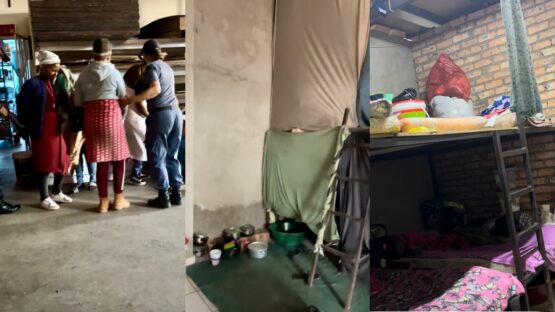
Image supplied by the Bargaining Council of KwaZulu-Natal.
Not so proudly South African
In recent times, various retailers have emphasized their commitment to local production. However, Alberts contends that South African retailers “didn’t just suddenly become altruistic and proudly South African.”
“Retailers seek well-priced items that are affordable for their customers. Their sourcing decisions are indifferent to where the products come from,” he remarked.
A senior procurement officer at a major retailer, speaking on the condition of anonymity, indicated that the shift toward local sourcing was primarily due to “strictly economic reasons.”
“An order from a South African factory typically takes between 30 to 45 days for delivery if all necessary materials are available, while garments produced in China take around 90 days. There’s a marked push to reduce dependency on China and India, especially after the disruptions experienced during the COVID-19 pandemic. Additionally, the exchange rate has also encouraged local sourcing,” the source added, emphasizing that the number of CMT factories in Newcastle “has surged in recent years to satisfy rising demand.”
Read:
TFG opens new Joburg clothing factory for the hearing impaired
South African retailers pivot from China to local garment sourcing
Concrete data on CMT factories in Newcastle is scarce (the municipality indicates that engagement with the sector is challenging due to language differences and a culture of opacity). But Alex Liu, the prior chairperson of the town’s Chinese Chamber of Commerce, reported that the number of CMT factories grew from “around 20” from 2000 to 2005 to over two hundred by 2021, though currently sits between 120-140.
ADVERTISEMENT:
CONTINUE READING BELOW
He contests the Bargaining Council’s assertion that there are 300 CMT factories in Newcastle.
As the number of CMT factories increased, competition for orders heightened, resulting in a reduction in fees paid to factories, Alberts explained.
Factories are offered a specific price for producing a given garment, identified as the CMT price. Retailers do not determine this CMT price; design houses do. However, Alberts observes that the prices factories receive are influenced by the rates retailers pay their design houses.
“I continually urge the major retailers to offer their suppliers slightly higher payments, to elevate the CMT prices,” he said, advocating for factory owners to establish a minimum unit price per item.
“We have facilitated the creation of Taiwanese and Chinese business chambers, yet no consensus on minimum pricing has been reached, as the Chinese owners are excessively competitive,” Alberts noted, explaining that suppliers thus “view Newcastle as a prime opportunity for bargain basement prices.”
“They obtain a quote from one factory and present it to another to see if they can secure a better deal. Often, after pricing around, the lowest quotation falls below economic viability, leaving the factory owner with no choice but to accept it just to keep operations running,” he detailed.
One factory owner, preferring to stay anonymous to avoid losing business, disclosed to GroundUp that in some instances, the CMT prices for T-shirts are even lower than they were in 2015.
“For a basic T-shirt priced at R80, retailers will pay the supplier [design house] between R30-40, and the supplier will pay the factory a CMT rate of roughly R3.50,” claimed the source, citing that the ANC placed a direct order for 1.5 million T-shirts with a Newcastle factory prior to the 2021 municipal elections, offering a CMT price of merely R2.85 per shirt.
“The factory had to cover costs for cotton, cutting, sewing, cleaning, and pressing the garment—all for just R2.85. While I’m not defending factory non-compliance, it’s important to understand the driving factors: businesses aim to survive. If they are constrained by CMT pricing, that inevitably impacts the wages paid to workers,” the source added.
GroundUp reached out to the ANC for comments on these allegations but received no reply.
Liu, who also owns a factory, lamented the rising overhead costs of operating a business.
“Cotton thread must be imported, and costs fluctuate based on the dollar exchange rate. In 2018, the rate was R13.25 per dollar. Currently, it stands at R16 to R17, resulting in a 50% increase for cotton threads. Meanwhile, all other input costs are escalating, including electricity,” he explained.
Typically, labor expenses account for 50% of total operational costs in CMT factories. Given the increasing input costs and the low CMT prices offered, most factory owners with whom GroundUp spoke noted their inability to meet the minimum wage standards set by the National Bargaining Council.
Read: New rebate on certain imported yarns and textiles is complex
“The public narrative surrounding Newcastle is filled with allegations of severe labor abuses, Chinese sweatshops, and so forth, and while these issues do exist—such as the employment of undocumented workers—it’s crucial to highlight the tangible market pressures contributing to these conditions,” Alberts affirmed.
Fallout
Following the parliamentary oversight in Newcastle, South Africa’s major retailers reached out to their design houses, demanding accountability regarding factory conditions. Consequently, Pepkor informed GroundUp that it has blacklisted one factory; The Foschini Group stated it imposed a penalty against a third-party supplier, while Pick n Pay confirmed that after discovering a design house was utilizing an unapproved CMT, “the relationship was terminated immediately. The product was also not released for sale.”
Alberts noted that since February, several factory owners in Newcastle have shut down operations, with others exploring relocation to Eswatini and Lesotho.
ADVERTISEMENT:
CONTINUE READING BELOW
Read: Future of Lesotho’s textile industry hangs in the balance
Flouting the law
To be deemed fully compliant, a clothing factory in South Africa must adhere to a comprehensive framework of labor laws, negotiate industrial bargaining agreements, and follow health and safety regulations and tax obligations.
Among other prerequisites, it must possess a Certificate of Compliance (CoC) from the National Bargaining Council, where employers and trade unions collaborate to negotiate collective agreements concerning wages, working conditions, and benefits across specific industries.
This agreement is officially extended by the Minister of Labour to all employers nationwide.
Fachmy Abrahams, the national bargaining officer for the Southern African Clothing and Textile Workers’ Union, pointed out that minimum rates established by the bargaining council often exceed the national minimum wage, which was updated to R30.23 per ordinary hour in March 2026.
The current minimum rate set by the bargaining council for an experienced mechanist in a non-metro area like Newcastle stands at R1 443.50 weekly (for 45 hours), translating to R32 per hour.
Typically, factories pay less than 80% of the national minimum wage.
Read: National minimum wage rises to R30.23 per hour
“What we witness in Newcastle is a situation where many employers not only fail to comply with bargaining council rates but also significantly neglect even the most basic employment standards,” Abrahams remarked.
The rise of clothes manufacturing in Newcastle
The story of the CMT sector in Newcastle traces back to the late 1990s, as Ferdie Alberts recounts, who encouraged investment from Taiwan when Arcelor Mittal—then the economic mainstay of Newcastle—began downsizing.
“We attracted considerable investment [from Taiwan], largely within the knitwear industry and also in plastics, but the clothing sector started gaining traction, particularly after 1997 when South Africa established formal diplomatic relations with the People’s Republic of China. Many businesspeople who settled in the area lacked the financial resources to establish fully operational factories, which led to compliance challenges from the onset,” Alberts reflected.
According to Liu, the current number of operational CMT factories in Newcastle ranges between 140-160, employing tens of thousands of workers, though some believe that the factory count is still on the decline.
GroundUp engaged with both the Newcastle Municipality and the KwaZulu-Natal office of the National Bargaining Council regarding CMT numbers in Newcastle, but neither could provide concrete statistics.
The rapid expansion of CMT factories is intricately linked to a distinct Chinese business culture, Liu, who is Taiwanese, notes.
“During the years 2000-2005, wages in South African factories were notably higher than those in China, which enabled Chinese-owned enterprises in Newcastle and beyond to recruit seasoned Chinese line supervisors and adept machinists, especially since obtaining work visas was relatively straightforward at that time.”
Liu revealed that these supervisors could save between R2,000 to R5,000 monthly, allowing them, after a year or two of work, to amass around R100,000 to launch their own small factories with merely one production line and perhaps ten workers. The rising demand for locally produced clothing catalyzed the growth in factory establishments.