
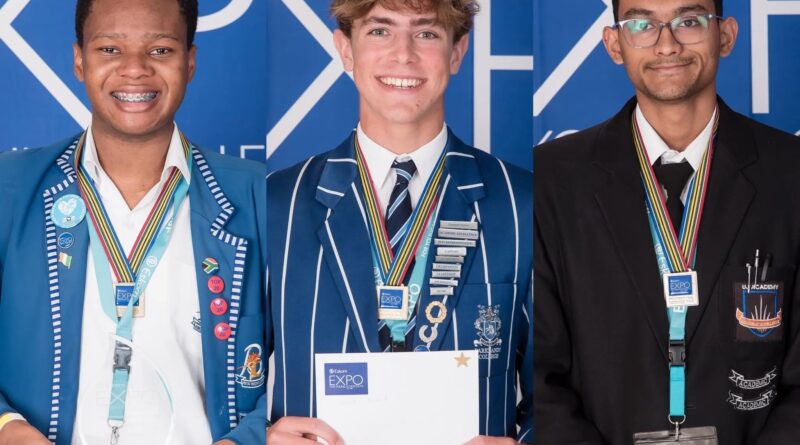
South African Young Scientists Address Global Challenges at Regeneron ISEF in the U.S.
Johannesburg – Three talented young scientists are poised to represent South Africa at the esteemed Regeneron International Science and Engineering Fair (ISEF) in the United States.
They will be presenting groundbreaking research that tackles urgent global issues in environmental sustainability, space science, and advancements in biomedicine.
The Regeneron ISEF is recognized as the largest pre-college science, technology, engineering, and mathematics (STEM) competition in the world.
Scheduled to take place at the Phoenix Convention Center in Phoenix, Arizona, U.S., from May 9 to 15, 2026.
Approximately 1,800 high school students from over 80 countries, regions, and territories will showcase their research projects, with various prizes available to be won.
The three participants, who were Gold and Silver medal recipients at the Eskom Expo International Science Fair (ISF) 2025, come from Johannesburg and Cape Town, and will be accompanied by Eskom Expo’s Northern Cape Provincial Coordinator, Katlego Tsogang, as they compete in Phoenix.
The learners include:
Ms. Mologadi Motshele, Acting Chief Executive Officer of the Eskom Development Foundation, stated: “Eskom’s ongoing support for the Eskom Expo for Young Scientists is essential in preparing South African learners for competition on prestigious international platforms like the Regeneron ISEF.
“Local learners’ participation at this level highlights the strength of our country’s burgeoning research and innovation ecosystem.
“Eskom is dedicated to cultivating future scientists, engineers, and innovators by providing opportunities that extend beyond class and into the global arena.
“We wish the participants the best as they represent our nation among the world’s elite young scientific talents.”
Parthy Chetty, Executive Director of Eskom Expo, remarked: “We are proud to recognize these three young scientists, Tiro, Gerhard, and Rudra, for standing as representatives of our country at the Regeneron ISEF, the world’s largest pre-college science competition.
“Their curiosity, thorough research, and collaborative spirit embody academic excellence and serve as an inspiration to other young South Africans.
“We appreciate the mentors, families, and schools that nurture talent and provide crucial support.”
Chetty further added: “Their achievements illustrate how bold inquiries and disciplined research can unlock global opportunities.
“We urge other students to engage in STEM, seek mentorship, and participate in competitions that challenge and elevate their ideas.
“Together, we celebrate innovation, resilience, and the future leaders of science.”
District Expos are now taking place in all provinces across the country.
Students in Grades 4 to 12, as well as Technical and Vocational Education and Training (TVET) NC(V) Level 2-4 students, can register their research projects by visiting www.exposcience.co.za
| Learner | Project |
| Tiro Moyo, 19 Grade 12 Bryanston High School Johannesburg |
Project name: Predicting Urban Expansion and Green Space Loss in Gauteng Province Using Sentinel-2 MSI Satellite Imagery and Machine Learning Project summary: The project demonstrated a significant increase in urban land cover. A Random Forest classification model, combined with an Artificial Neural Network for future projections, achieved reliable accuracy, confirming the robustness of the methodology. Compared to traditional mapping approaches, this integrated system enables more efficient and precise monitoring of land cover dynamics. The study provides a promising and scalable framework for supporting evidence-based policy, reinforcing the need for strengthened green space conservation and urban planning strategies. |
| Gerhard Vosloo, 17 Grade 11 Parklands College Cape Town |
Project name: A machine-learning driven approach to detecting gravitational wave signals from LIGO Project summary: The research demonstrates that a machine-learning-driven model can detect gravitational wave signals embedded in noise with notable accuracy. Compared to conventional pipelines, the approach offers a significant reduction in computational demand, with promising potential for real-time signal detection. The project underscores the growing role of artificial intelligence in advancing astrophysical research and opens up pathways for more efficient and accessible data analysis frameworks. |
| Rudra Patel, 16 Grade 11 UJ Academy Maths, Science & ICT School of Specialisation Johannesburg |
Project name: Predictive AI-Based Genomic Optimisation of Donor Pig Livers for Human Xenotransplant Compatibility Project summary: The project demonstrated that an AI-driven model can reliably prioritize gene-editing strategies for pig-to-human liver transplantation. The model successfully identified key immunogenic genes, aligning with established biological evidence. The learner’s findings highlight a promising and scalable pathway for enhancing xenotransplant compatibility. This approach holds potential for accelerating the development of viable donor organs, contributing to more efficient and accessible transplantation solutions globally. |
*This article first appeared in our sister publication techfinancials.co.za