

Electric Minibus Taxis Set to Arrive in Cape Town
Minibus taxis are a common sight throughout southern Africa, serving as a vital element of the urban economy by providing economical transport options for millions. In Cape Town, the second-largest city in South Africa, these vehicles play a crucial role in public transport.
Approximately two-thirds of the city’s public transport users depend on paratransit services that are flexible and responsive to demand, operating around 1,466 routes and transporting about 830,000 passengers daily. These services are largely managed by private operators rather than the government.
However, since these vehicles predominantly use petrol and diesel, they contribute to greenhouse gas emissions, worsen urban air quality, and escalate fuel costs.
The global movement away from internal combustion engines is gaining momentum, and public transport must be included in this transition. The challenge of electrifying this sector surpasses merely swapping one vehicle type for another. In African paratransit systems, it poses a trickier question: how can the vehicle be transformed without jeopardizing the essential service that so many rely on?
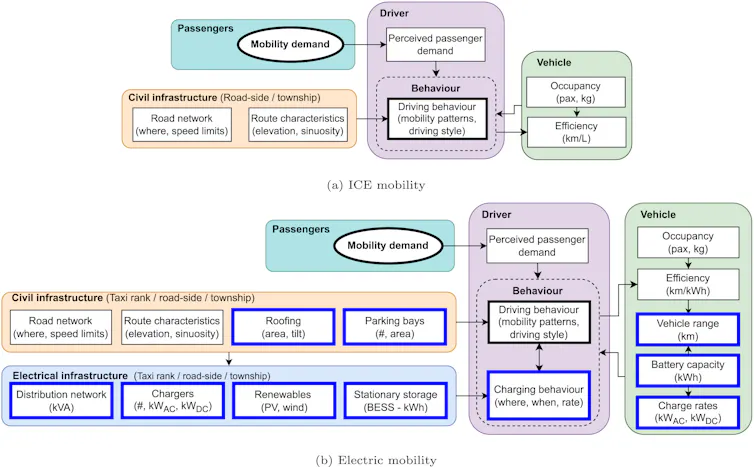
Electric minibuses would fundamentally alter operations, including their stopping patterns, grid interactions, and decision-making processes of drivers. Additionally, they would necessitate a charging infrastructure that aligns with the operational rhythms of taxi ranks, neighborhoods, and routes, ensuring service is not disrupted.
With Cape Town planning to initiate its first fully electric minibus taxi routes in Century City by 2026, the transition to electrification is not just a distant goal. It is crucial to explore how it can function effectively for operators, passengers, and the electricity grid.
As a team of engineering researchers focusing on transport electrification in sub-Saharan Africa, we have conducted multiple studies analyzing the environmental and financial viability of electric vehicles considering current mobility patterns, charger locations, accessibility, and altered driving and charging behaviors.
Our latest findings indicate that while electrifying minibus taxis is both necessary and feasible, it presents a complex challenge involving environmental trade-offs, grid limitations, operator costs, and equity issues. Although our studies center on Cape Town, the insights gained are applicable to various African cities where paratransit is crucial for daily mobility.
Environmental Perspective
The global discourse on electric vehicles often presents them as an unequivocal solution for the climate crisis. However, this narrative does not necessarily apply universally, particularly in regions where electricity generation heavily relies on fossil fuels. In South Africa, coal constitutes about 83% of electricity production.
ADVERTISEMENT
CONTINUE READING BELOW
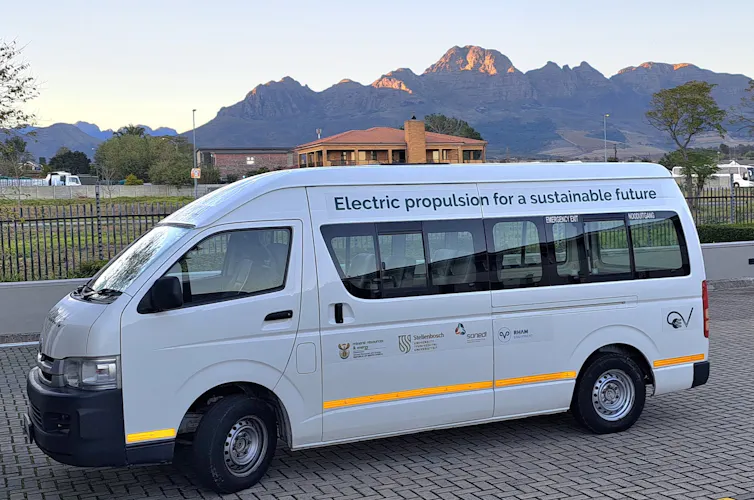
Utilizing real minibus taxi mobility data from Cape Town, our research evaluated the energy consumption, emissions, and costs associated with electric versus conventional minibuses. Surprisingly, the findings showed that under current grid conditions, an electric minibus taxi produces about 14% more carbon dioxide equivalent emissions compared to a standard diesel minibus. Charging an electric taxi on a coal-intensive grid may generate more greenhouse gases than operating a diesel vehicle.
However, this isn’t the complete narrative. Electric minibuses provide significant environmental and health advantages, eliminating tailpipe particulate emissions, decreasing brake wear, and reducing noise pollution.
These local benefits are especially important in densely populated urban areas where residents live near busy roads. As South Africa transitions its power generation towards more renewable sources, the climate benefits of electric minibus taxis will also improve.
The conclusion is not that electric taxis are undesirable. Rather, they represent a long-term solution for the climate crisis, with immediate benefits primarily visible in cleaner air, reduced noise, and improved urban health.
Energy Perspective
The electrification of Cape Town’s minibus taxi fleet would significantly increase electricity demand. According to one study, an average vehicle consumes about 50.8 kWh per day, aggregating to approximately 460 MWh daily across a fleet of around 9,000 vehicles, which is equivalent to the energy consumed by about 65,700 homes. The critical consideration is not just the volume of energy needed but also the timing and locations of vehicle charging.
Shifting the focus to newer findings, one might assume the solution involves merely installing faster chargers at taxi ranks. However, our models indicate that access to charging plays a more critical role compared to charging speed alone. Access to home or secure neighborhood charging significantly influences the sustainability of current mobility patterns and the system’s overall performance when driver behavior adapts.
A typical daily charge of approximately 50 kWh may take around two to three hours on a 22 kW charger or about an hour on a 50 kW charger, though actual charging times can vary. Nonetheless, faster charging doesn’t resolve the core issue: drivers need reliable locations and sufficient stationary time to charge without jeopardizing service or losing potential income.
Additionally, our studies demonstrate that charging stations should not be exclusively designated for formal taxi ranks. Infrastructure at stops and informal locations is essential, as this aligns with how paratransit typically operates.
ADVERTISEMENT:
CONTINUE READING BELOW

The consequences of electrification will not be evenly distributed. Due to the lingering effects of apartheid-era geography, operators in historically marginalized neighborhoods are more susceptible to issues when home charging is not an option. Thus, the consideration of charging infrastructure extends beyond technical aspects and encompasses issues of equity as well.
Furthermore, there exists a challenge with the grid. Charging solely at depots could lead to spikes in electricity demand during early morning and daytime hours, whereas home charging may shift this demand to the evening residential peak.
If not managed effectively, increased demand could exacerbate strains on an already unstable electricity system. However, implementing time-of-use pricing, controlled charging processes, and improved alignment with solar and other renewable energy sources could facilitate a more seamless integration of electric taxis.
Operators’ Perspective
For taxi operators, transitioning to electric vehicles presents complex financial implications. One comparison indicated that the electric alternative costs approximately 1.5 times more than the diesel Toyota Ses’fikile—a 16-seater minibus that currently dominates the market. Many operators function on tight profit margins and face high financing costs.
Financing costs add another layer of complexity, often requiring a 10% deposit and a 20% interest rate over a 72-month repayment period. Many operators could also be perceived as high-risk by lenders, making them struggle to access financing.
On the plus side, the operating cost for electric minibuses is significantly more favorable. Energy expenses can be 33% to 57% lower than diesel fuel costs, and electric motors require less maintenance. This scenario for operators presents a trade-off between higher initial costs and lower ongoing expenses, where the outcome is highly contingent upon electricity pricing, financing terms, and access to reasonably priced charging.
Preparing for Electrification
Thorough planning and simulations are essential to roll out electric minibus taxis effectively. Policymakers must grasp the interplay among vehicle energy demand, charging infrastructure, grid capacity, driver behavior, and passenger service.
Our research utilized simulations to model driver behavior within an electrified paratransit framework. Unlike formal bus systems, minibus taxi drivers adapt their routes, stops, and charging based on passenger demand and competition.
ADVERTISEMENT:
CONTINUE READING BELOW
Our simulations indicate that constrained depot charging leads to increased wait times and reduced trips served. Conversely, incorporating home charging significantly alleviates depot congestion while maintaining service quality.
This distinction is crucial because electrification encompasses more than just the vehicles and chargers; it also entails understanding how informal transport systems function. Planners must avoid treating taxi operations like coordinated bus fleets, as this could result in ineffective interventions.
A more effective strategy involves planning around actual mobility patterns, charging behaviors, and community disparities.
Engaging taxi operators, municipalities, energy providers, and communities is imperative. The benefits of cleaner air and reduced noise must be considered against the present emissions profile of the grid. Operator economics must be enhanced through improved tariffs and financing options.
Moreover, charging infrastructure needs to be developed in not just depots and ranks but also in neighborhoods and informal stops that shape daily paratransit operations.
Through targeted subsidies, better access to overnight charging, investment in renewable energy, and robust policy support, Cape Town can initiate a transition towards public transport that is cleaner, more feasible, and more equitable. Getting this right could set a model for cities across Africa.
MJ (Thinus) Booysen, Professor in Engineering, Stellenbosch University and Joshua Sello, Postgraduate Student in Electronic Engineering, Stellenbosch University
This article is republished from The Conversation under a Creative Commons license. Read the original article.