

UK Graduates Pursue Emergency Degrees to Navigate Job Market Crisis
When Cameron Weston-Edwards missed out on an internship with a historical tour company in rural England, he realized he needed to make a change. “If I’m getting rejected for that, the odds of securing a graduate job are low,” the 22-year-old politics student explains. “I obviously need to enhance my CV.”
Weston-Edwards is one of many young individuals across Europe and the US who hope that pursuing a master’s degree will provide an edge in the most competitive job market in years, as employers cut back on vacancies amid global economic uncertainty and the increasing impact of artificial intelligence.

Cameron Weston-Edwards outside the Parkinson Building at the University of Leeds. Image: Lorna Mackay/Bloomberg
US law school applications have surged by 32% this year compared to the average over the past four years, according to official statistics. In continental Europe, three-quarters of business master’s programs received more applications in 2025 than the previous year, a rise from about half in 2023, a Graduate Management Admission Council survey revealed.
Read:
UK risks losing 8 million jobs due to AI, warns analysis
Google to invest £5 billion to enhance AI development in the UK
Trade disruptions could eliminate 90,000 green jobs in the UK, study finds
In the UK, class sizes are increasing, as are the ranks of university faculty: ‘lecturer’ is now the third fastest-growing job on LinkedIn, surpassing roles like machine learning researcher and investment broker. This trend mirrors the aftermath of the global financial crisis, when many young people returned to education to endure the job drought.
The UK faces a particularly severe jobs crisis. Increased payroll taxes and a rising minimum wage have deterred businesses from hiring school graduates, while university alumni are competing against a service sector exploring the potential of AI.
ADVERTISEMENT
CONTINUE READING BELOW
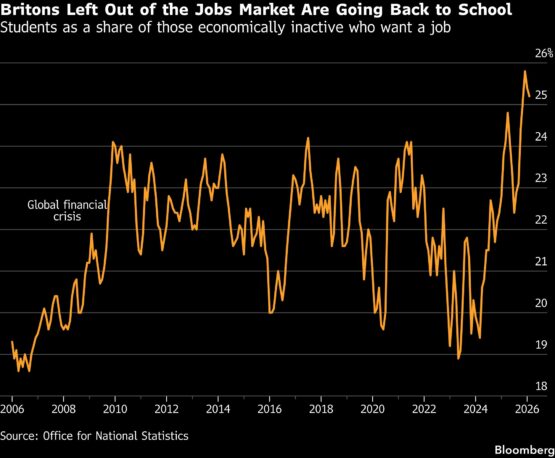
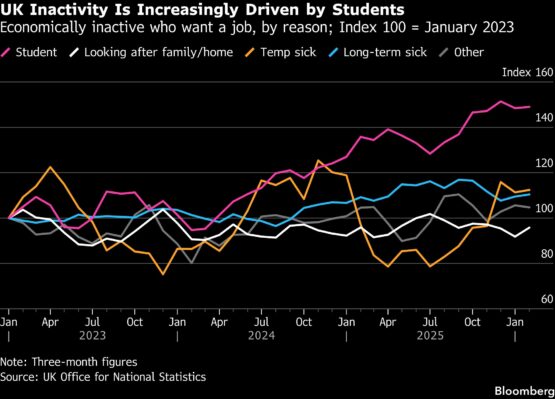
The UK youth unemployment rate is the highest since 2015, with an increasing number of young people struggling to find work for over a year. More than 500,000 Britons seeking employment have left the workforce to study, and students now make up over a quarter of those not working but desiring a job.
For Weston-Edwards, obtaining a postgraduate qualification is crucial. The internship he was rejected from went to someone holding an MA in history, prompting him to accept an offer to pursue a master’s in political communications later this year.
Read: The evolving economics of individuals in a world of narrowed prospects
Enrollment in taught postgraduate courses in the UK increased by 8% for the year leading into 2024/25, after several years of decline, according to the latest official data. Practical degrees linked to traditionally strong industries, such as finance, are particularly sought after.
Applications for postgraduate programs at Bayes Business School in London surged almost 10% for the 2025/26 academic year, representing a notable increase from previous years, with staff reporting even stronger admissions this cycle.
Meanwhile, students in mainland Europe are having similar experiences. Lauren Amdor, 23, is about to embark on a master’s program in international governance and diplomacy at Sciences Po in Paris this August. The program’s six-month internship and the opportunity for career mentorship from instructors, many of whom are working professionals, were major attractions for her.
“The career support currently available to students is considerably easier to access compared to those outside education,” she comments.
ADVERTISEMENT:
CONTINUE READING BELOW
Graduates are entering a reality vastly different from what they envisioned when they started their degrees, as the AI revolution was just beginning at that time. A postgraduate qualification represents a means to rapidly acquire new skills after being “locked into a degree for three years,” explains Cormac Bryce, associate dean for MSc programs at London’s Bayes Business School.
Read: Graduated, now what?
In the US, law degrees are at risk of losing their status as strong guarantees of employment. Even deans of law schools recognize that by the time the class of 2029 graduates—those beginning law school this fall—the entry-level job market may be significantly altered.
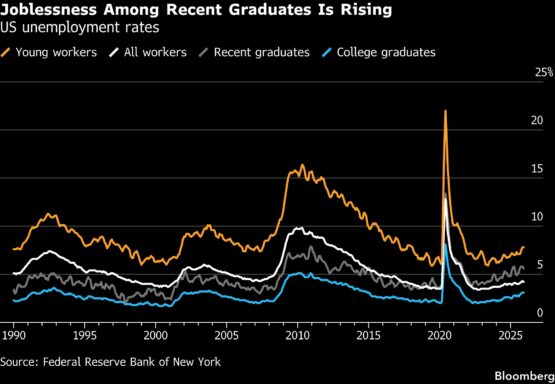
This raises questions about whether to enroll fewer students. While administrators suggest that significant reductions in class sizes aren’t expected soon, they also acknowledge the risks of making promises that might not be fulfilled.
“Nothing causes faster discontent among students than feeling misled,” remarked James Leipold, senior advisor to the Law School Admission Council, in a recent piece regarding law schools’ enrollment strategies.
Read: The repercussions of a disillusioned youth
Sean Fitzpatrick, CEO of AI research platform LexisNexis’s global legal segment, is cautioning that the US may have reached “peak legal” in terms of recruitment. “I don’t anticipate seeing growth in the number of jobs in law firms for the next couple of years,” he added.
ADVERTISEMENT:
CONTINUE READING BELOW
In fact, data from the National Association for Law Placement indicates that recruitment at major US law firms for full-time positions is already showing signs of deceleration.
During a recent dinner with several managing partners, Fitzpatrick noted that this year’s first-year associate class is likely to be the same size or smaller than in previous years. While the partners expect business growth, they believe that AI will enable current staff to manage the increased workload.
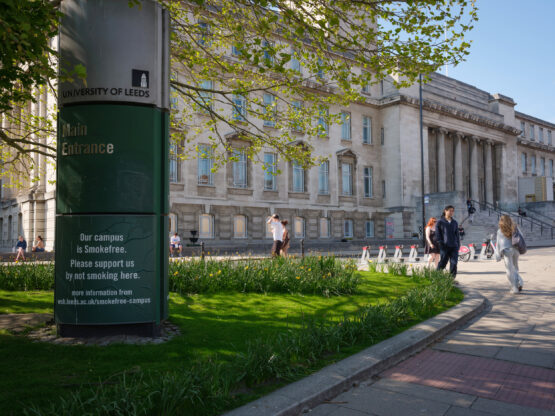
The University of Leeds, where Weston-Edwards will pursue his postgraduate degree. Image: Lorna Mackay/Bloomberg
In contrast to the job market, Weston-Edwards found himself with several options for postgraduate studies. He applied to two programs and received offers from both. When it came time to make a decision, he quickly moved beyond discussions of course content and structure, prioritizing one critical question: would it enhance his employability?
Read: The rising challenge of unemployment
“Employability was undoubtedly the top priority,” he stated. “A lot of individuals pursue a master’s now mainly due to the state of the job market rather than a personal drive to further their education.”
© 2026 Bloomberg