

Oil Soars Amid Iran Tensions as US Stock Futures Decline
Oil prices surged while US equity-index futures declined as traders adopted a more cautious stance following heightened US-Iran tensions over the weekend, dampening hopes for easing conflicts in the Middle East.
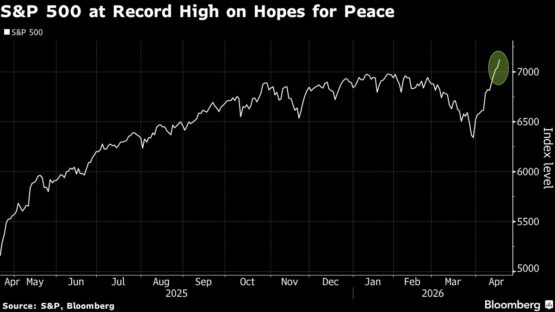
Brent crude rose nearly 5% to just below $95 per barrel, with natural gas prices also climbing after the US Navy intercepted an Iranian vessel during a tumultuous weekend marked by Tehran targeting ships and reinstating restrictions in the Strait of Hormuz. S&P 500 futures decreased by 0.5%, after the main index reached a record high on Friday amid Iran’s earlier claim of a “completely open” waterway.
Treasury yields fell across the board amid worries that rising oil prices could heighten inflation. The dollar, traditionally a safe haven during conflicts, inched up after a three-week decline spurred by hopes for a resolution to the war.
Read: Seesaw situation: Iran claims the Strait of Hormuz is closed
Will oil prices ever revert to ‘normal’?
Nevertheless, most of Monday’s relatively modest movements reverted markets to last week’s figures, when diplomatic resolution optimism boosted sentiments. MSCI’s Asian share index advanced by 0.6%, encouraged by hopes of de-escalated tensions while a measure of emerging market stocks fully regained losses triggered by the war.
Renewed tensions and disruptions in the Strait of Hormuz threaten to introduce volatility back into the markets after a broad easing of war-related risk premiums over the past fortnight. With a two-week ceasefire set to end on Tuesday, attention is now on whether the US and Iran can restart negotiations to alleviate tensions and open the critical waterway following unsuccessful talks in Islamabad.
“It seems that we are somewhat treading the same circles,” Kerry Craig, a global market strategist with JPMorgan Asset Management, remarked on Bloomberg TV. The markets “are looking beyond what could potentially be the end or at least the inception of the end of this conflict.”
ADVERTISEMENT
CONTINUE READING BELOW
President Donald Trump and Iranian representatives conveyed differing perspectives on the next phase of the war, leaving uncertainty over upcoming peace talks as the ceasefire nears expiration.
Iran has hinted it may abstain from a second round of discussions this week while the US persists with a naval blockade, intensifying a standoff that had recently appeared to ease and fueled a significant rally in stocks.
Trump, who indicated on Friday that a deal with Iran was nearly finalized, threatened by Sunday to demolish every power plant and bridge in Iran if negotiations falter. This rapid shift highlights how last week’s rally was more rooted in hope than actual resolution.
“Despite various developments over the weekend, things didn’t take a turn that would precipitate a breakdown in ceasefire negotiations, as had been feared,” said Yugo Tsuboi, chief strategist at Daiwa Securities Co. “Therefore, market reactions have remained composed for now.”
Elsewhere in the market, gold dipped 0.4% to $4,810 an ounce, while silver fell 0.6%. Bitcoin showed little change, trading around $74,700. The yield on 10-year Treasuries rose by two basis points to 4.27%. European bond futures also saw slight declines.
European gas futures spiked as much as 11% on Monday after Tehran reinstated control over the chokepoint, claiming the US blockade of Iran-linked vessels breached the ceasefire agreement.
Earlier on Friday, the S&P 500 recorded its third consecutive week of gains above 3%, marking its largest monthly increase since 2020. Indices in Taiwan, Singapore, and China’s CSI 300 Index all rebounded from losses incurred following US and Israeli attacks on Iran in late February.
South Korea’s Kospi index rose as much as 1.4% on Monday, erasing losses sustained since the conflict’s onset.
“I believe we’re approaching or may already be at peak uncertainty, although I recognize there is hedging risk,” said Billy Leung, an investment strategist at Global X Management. “The recent selloffs occur on thin volume, indicating positioning rather than conviction.”
ADVERTISEMENT:
CONTINUE READING BELOW
Here are some key movements in the markets:
Stocks
- S&P 500 futures decreased by 0.6% as of 11:58 a.m. Tokyo time
- Nikkei 225 futures (OSE) gained 0.5%
- Japan’s Topix rose 0.7%
- Australia’s S&P/ASX 200 remained relatively stable
- Hong Kong’s Hang Seng index increased by 0.8%
- The Shanghai Composite index rose 0.6%
- Euro Stoxx 50 futures fell by 1.1%
Currencies
- The Bloomberg Dollar Spot Index climbed 0.1%
- The euro remained steady at $1.1756
- The Japanese yen decreased by 0.2% to 158.91 per dollar
- The offshore yuan was largely unchanged at 6.8184 per dollar
Cryptocurrencies
- Bitcoin fell by 0.2% to $74,491.63
- Ether remained stable at $2,279.95
Bonds
- The yield on 10-year Treasuries increased by two basis points to 4.27%
- Japan’s 10-year yield decreased by two basis points to 2.400%
- Australia’s 10-year yield fell by six basis points to 4.93%
Commodities
- West Texas Intermediate crude increased by 6.2% to $89.06 per barrel
- Spot gold dropped by 0.7% to $4,795.06 an ounce
© 2026 Bloomberg