
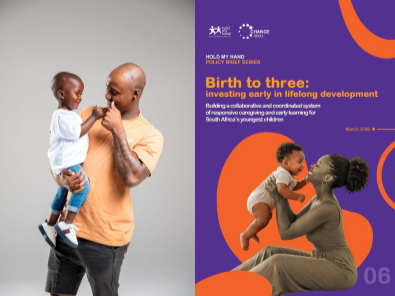
Policy Brief Advocates for ‘Birth to Three’ Investments to Disrupt the Cycle of Inequality
Johannesburg – The government’s recent policy brief, “Birth to three: Investing Early in Lifelong Development,” emphasizes the need for increased investment during the crucial first three years of life, a period marked by rapid brain development and heightened receptiveness to interaction and care.
In response to the policy brief, Hold My Hand recognizes that South Africa has achieved significant advancements in expanding early childhood development (ECD) for four- and five-year-olds.
Nonetheless, Hold My Hand asserts, “Efforts must persist until every three-to-five-year-old has the opportunity for out-of-home early learning experiences.”
Hold My Hand serves as a national communications and social mobilization campaign supporting the National Strategy to Accelerate Action for Children (NSAAC), prioritizing the rights and well-being of children and teenagers in South Africa.
Formed through a collaboration between the Presidency and the DG Murray Trust, the Hold My Hand Accelerator for Children and Teens aims to expedite certain priority strategies outlined in the NSAAC.
Most essential skills for school readiness are acquired before a child even steps into a classroom, primarily through everyday interactions with parents and caregivers, who act as their initial educators.
The experiences at home are crucial in shaping a child’s readiness to learn long before formal schooling starts.
Many adults are unaware of the significant influence that early brain development plays in a child’s life and could benefit from resources to harness this potential.
Neuroscience validates that brain development is most dynamic and sensitive between birth and age three.
During this critical period, everyday interactions—like talking, playing, and addressing a baby’s needs and communication attempts—construct the neural foundations for memory, attention, and emotional regulation.
By the time children join early learning programs, many of these foundational elements may already be established or absent.
With approximately one million infants born each year, the majority of young children do not participate in early learning programs.
By the time they reach these programs, many developmental gaps—particularly in language and early learning—are already evident, limiting their ability to benefit from subsequent educational investments.
In the absence of a coordinated strategy to assist these families, developmental disparities that reflect biological markers of inequality become entrenched long before a child enters a classroom.
The policy brief, published by Hold My Hand and Change Ideas in support of the National Strategy to Accelerate Action for Children (NSAAC), underscores the vital role of caregivers in fostering early learning during this phase.
“Neglecting the birth-to-three period curtails the effectiveness of all subsequent ECD and school reforms,” asserts Mikhaila Steenkamp, Language and Learning Lead at Hold My Hand.
“The cognitive and socio-emotional foundations for learning are significantly influenced, or compromised, before a child reaches preschool.
“Fortifying the home as the primary environment for early learning offers the highest return on investment for long-term productivity.”
The policy brief identifies the main barrier to supporting infants and toddlers as not being affordability, but rather the structure of financing mechanisms.
While there is investment in ECD in South Africa, sustained funding mechanisms for home-based caregiver support are limited, and many initiatives remain fragmented and reliant on donor contributions.
Key recommendations from the policy brief include:
- Allocating a small portion of existing ECD and Department of Health budgets to establish a distinct “birth to three” financing framework.
- Integrating “Love, Play, Talk” guidance throughout routine health interactions, specifically utilizing Community Health Worker (CHW) outreach and the Road to Health Booklet (RtHB).
- Funding a national network of civil society and community-based organizations to expand evidence-informed, light-touch parenting models that reach families in their communities.
- Ensuring that infants, toddlers, and their caregivers are recognized in national monitoring systems and investing in common, impactful metrics.
“The real question is not whether South Africa can afford to invest in the initial three years,” states Phylicia Oppelt, Project Lead at Change Ideas.
Yet, as the brief concludes, “Can we afford not to? Early intervention can prevent inequality from becoming entrenched and ensure that every child begins life with the necessary relationships and support to thrive.”
For additional details or to download the policy brief, visit https://www.holdmyhand.org.za/policy-briefs or Change Ideas.