
Five Reasons Why Global Markets Remain Resilient Amidst the Conflict in Iran
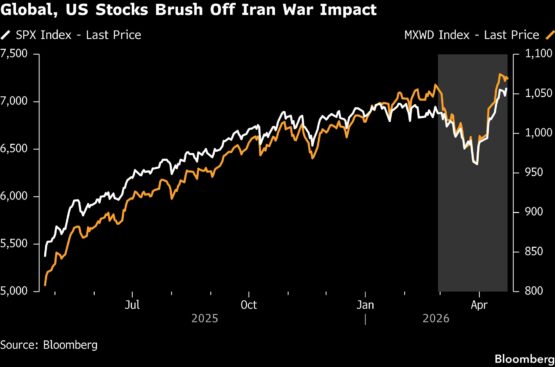
As the conflict in Iran stretches into its second month, global stock markets are making a surprising comeback. From the US to Taiwan and South Korea, there is a noticeable disconnect: despite ongoing geopolitical tensions, equities are moving toward previous record highs.
Initially shaken, financial markets have largely shifted their focus from the conflict to corporate fundamentals, even with oil prices remaining high. Investors are increasingly returning to artificial intelligence investments and emerging-market stocks, indicating that most of the volatility may be behind us. The US dollar has also relinquished much of its gain since the conflict began.
“Markets might be applying the ‘transitory’ concept to a scenario that could play out over a lengthy duration,” commented Magdalena Polan, head of EM macro research at PGIM Fixed Income. “Investors are prioritizing global liquidity, adopting an optimistic view of the fundamentals.”
ADVERTISEMENT
CONTINUE READING BELOW
Here are five reasons why the geopolitical conflict hasn’t led to a stronger negative market reaction:
Peak uncertainty
Analysts note that markets seem to have priced in the worst-case scenario while maintaining hope for a peaceful resolution. With officials from both Washington and Tehran remaining open to dialogue and a potential extended ceasefire, markets are bolstered by the belief that diplomacy could prevail instead of outright collapse amid ongoing tensions.
Dip-buying mentality
Quickly evolving headlines and President Donald Trump’s frequent policy shifts have surprised many investors. Many stakeholders draw parallels to the early 2022 Ukraine war response, where initial market declines quickly rebounded to a more stable state. A history of volatility driven by headlines has reinforced investors’ tendency to avoid prolonged bearish outlooks.
Oil cushion
While the energy supply shock stemming from the conflict has pushed oil and gasoline prices upwards, it hasn’t resulted in widespread economic shutdowns as many feared. Strategic petroleum reserve releases and some unused capacity from major oil producers, coupled with a contraction in demand, have helped cushion the blow. However, any extended disruptions in the Strait of Hormuz could amplify economic difficulties.
ADVERTISEMENT:
CONTINUE READING BELOW
Robust earnings
Strong corporate earnings have provided a much-needed boost to the markets. Approximately 80% of S&P 500 companies that have reported first-quarter results thus far have surpassed analyst expectations, according to Bloomberg data. Several analysts have revised earnings growth forecasts upward, leading to a more positive outlook on corporate fundamentals.
AI is back
Technology stocks have played a crucial role in driving the stock market rebound, showing resilience due to strong demand for artificial intelligence. On Thursday, SK Hynix announced a fivefold increase in quarterly profit, while Taiwan Semiconductor Manufacturing Co. raised its 2026 revenue outlook, and Samsung Electronics Co. reported an eightfold profit increase. Analysts suggest that future earnings and investment plans from major tech companies will serve as critical catalysts for further market growth.
© 2026 Bloomberg