
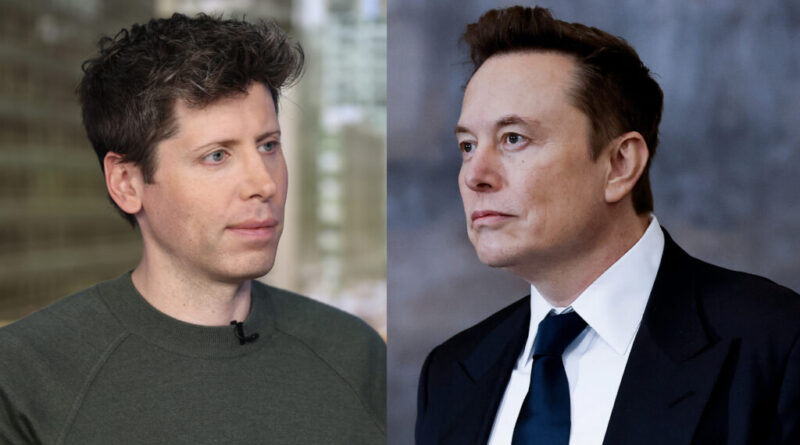
Musk Claims He’s Suing OpenAI to Halt Altman’s ‘Theft’
Elon Musk testified on Tuesday that he is suing OpenAI along with its co-founders, Sam Altman and Greg Brockman, because the startup’s transition from a charitable organization to a for-profit model is inappropriate and establishes a troubling precedent for other philanthropic initiatives.
“It is unacceptable to hijack a charity, that’s my perspective,” Musk stated to jurors at the beginning of a high-profile trial in federal court in Oakland, California.
This highly publicized trial marks the culmination of a long-standing rivalry and public disputes involving the three individuals who co-founded the organization in 2015, before their relationship deteriorated.
Musk emphasized that the implications of this legal battle extend beyond the individuals involved, warning that if Altman and Brockman’s actions are not considered improper, “this case could set a precedent for the exploitation of every charity in America.”
OpenAI’s lawyer, William Savitt, challenged Musk’s statements, urging US District Judge Yvonne Gonzalez Rogers to dismiss the testimony on the grounds that Musk is not a legal expert capable of providing legal insights. Gonzalez Rogers denied this motion.
In his remarks to the jury, Savitt contended that Musk’s lawsuit primarily aims to undermine a leading competitor to his own AI venture, xAI. He also pointed out that Musk had initially supported the idea of transforming OpenAI into a for-profit organization during its early days.
The verdict of the three-week trial could influence OpenAI’s future as it prepares for a highly anticipated public offering, potentially one of the largest ever, with the company nearing a trillion-dollar valuation. Musk seeks a judicial order to reverse the for-profit transition of OpenAI that was finalized in October.
Musk dedicated much of his initial testimony to outlining his various business endeavors, such as Zip2, PayPal, SpaceX, Neuralink, and Tesla. He noted his longstanding interest in artificial intelligence, paired with concerns about the technology surpassing human intellect.
Clad in a black suit and tie, as he has been in previous courtroom appearances, Musk appeared relaxed and engaged on the witness stand, even interjecting humorous remarks at times. The business tycoon has previously provided testimony in numerous legal battles across the nation, winning the majority of his cases.
Musk cautioned the jury about the potential dangers of AI, describing it as a “double-edged sword”—a tool that could lead to significant societal advancements, but also pose grave risks.
“It could lead to widespread prosperity, but it could equally bring about our destruction,” Musk expressed.
Around 2015, Musk indicated that he consulted with “anyone and everyone” regarding the capabilities of AI and his apprehensions about its development, including discussions with Google co-founder Larry Page.
ADVERTISEMENT
CONTINUE READING BELOW
Musk shared that he felt Page was “not sufficiently concerned about AI safety” and dismissed his inquiries regarding a future scenario where “AI annihilates humanity.”
“He said that would be acceptable as long as artificial intelligence survived,” Musk recounted. “Then he labeled me a speciesist for prioritizing humans over AI.”
Musk found this viewpoint “absurd” and became convinced that there needed to be a counterbalance to Google’s approach to AI, given that the company was a frontrunner in the field. At that time, he noted, they possessed “all the funding, all the computing resources, and all the talent for AI.”
“I wondered, ‘what could stand in contrast to Google?’” Musk pondered. “An open-source, nonprofit organization.”
Alphabet Inc.’s Google, which is not part of the trial, did not respond immediately to a request for comment.
Musk’s attorney, Steven Molo, informed the jury that the trial will reveal how Altman and Brockman exploited Musk’s financial contributions, reputation, and guidance to establish OpenAI—only to later abandon its mission focused on public welfare for their personal gain.
Molo claimed that Microsoft Corp. was complicit in this betrayal when the tech giant invested $13 billion into OpenAI starting in 2019, a year after Musk departed from the startup’s board.
According to Molo, Microsoft stood by as Altman and Brockman turn “OpenAI’s charitable mission into a farce,” as he presented to the jury of nine.
In his statements, Savitt countered that in OpenAI’s inaugural year as a nonprofit lab, Musk had suggested via email: “it might be preferable to have a standard C corp alongside a nonprofit.”
The following year, Musk expressed in another email that “it may have been a mistake for OpenAI to be established as a nonprofit, due to the advancements made by DeepMind,” Savitt noted, referring to a Google AI initiative.
By 2017, Musk and others within OpenAI acknowledged that the company required significantly more computing resources than previously anticipated. The founders engaged in “dozens” of meetings and agreed on the concept of establishing a for-profit branch.
“Throughout these intensive discussions in 2017, Mr. Musk never indicated that OpenAI should remain entirely nonprofit,” Savitt claimed. “In fact, the opposite was true.”
According to Savitt, Musk “wanted to convert OpenAI into a fully for-profit entity and have absolute control,” but “the other founders were reluctant to cede control of AI to a single individual.”
ADVERTISEMENT:
CONTINUE READING BELOW
Musk indicated during his testimony that he was always amenable to forming a for-profit subsidiary of OpenAI, provided that profit margins were capped and that any income generated was directed towards the nonprofit.
One proposal considered at that time suggested that the four key leaders at OpenAI would have an equal equity share in the for-profit division, including Musk, Altman, Brockman, and Ilya Sutskever, the organization’s chief scientist.
Musk expressed that this arrangement felt “unfair and inappropriate,” given that he was “providing all the funding” up to that point. He aspired to retain a majority interest in the for-profit branch, a stake he anticipated would diminish as more investors joined.
Currently, OpenAI’s nonprofit foundation continues to govern the organization. Following its transition to a for-profit entity last year, the company announced that it would remain under the oversight of the nonprofit, now known as the OpenAI Foundation. The nonprofit also received a 26% equity stake in the company, while Microsoft acquired a 27% stake.
Russell Cohen, an attorney for Microsoft, asserted that the conflict has little to do with the software company, which he claimed “has been a responsible partner from the start.”
“Together, Microsoft and OpenAI have financed one of the largest nonprofits in history,” he stated to the jury.
“In contrast to Mr. Musk, Microsoft never sought to dominate OpenAI,” Cohen contended. “It viewed the partnership as one of collaboration, benefiting all parties involved.”
The jury is expected to hear from a series of prominent witnesses and will be tasked with reviewing emails, text messages, and corporate documents related to OpenAI’s founders spanning several years.
The jury will deliver an “advisory verdict” upon completing the testimonies, with a final decision on Musk’s allegations—and any potential remedies—choreographed by Gonzalez Rogers, guided by the jury’s conclusions.
The case is Musk v. Altman, 4:24-cv-04722, US District Court, Northern District of California (Oakland).
© 2026 Bloomberg