
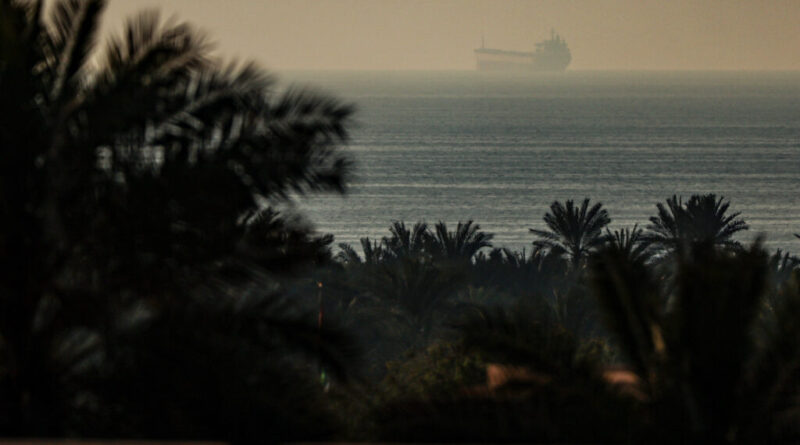
Aged Oil Tanker Hints at Iran’s Revival of Retired Vessels
A 29-year-old Iranian supertanker has resurfaced at Kharg Island after years of being off the grid, suggesting that Tehran might be utilizing decommissioned ships to continue oil loading as its storage capacity dwindles.
The Nasha, constructed in 1997, is an Iran-flagged very large crude carrier. According to satellite imagery reviewed by the advocacy group United Against Nuclear Iran and Bloomberg News, it was docked at Kharg Island, Iran’s largest oil-export terminal, as of Sunday.
Experts from Vortexa and UANI indicated that the vessel appears to have been reactivated after last delivering a cargo two to three years ago. It’s unclear what Nasha had been doing since its last detection—whether it was sailing, idle, or positioned inside or outside the Persian Gulf—since the vessel ceased broadcasting its location.
Read:
US has allocated $25bn to the Iran conflict so far – Pentagon
Government eliminates diesel tax to zero, extending fuel relief
The US blockade has left a growing number of tankers laden with Iranian oil stranded in the Persian Gulf or the Gulf of Oman, while other vessels are unable to navigate through the Strait of Hormuz for oil pick-up. Consequently, Iran is swiftly running out of oil storage options, with capacity anticipated to last no more than three weeks at the current pace, according to research firm Kpler this week.
Iran has shown resilience in enduring significant economic strains, but the presence of US warships in the Gulf of Oman will compel it to seek increasingly inventive solutions.
ADVERTISEMENT
CONTINUE READING BELOW
Read:
UAE to exit Opec in May as the Iran conflict transforms the oil market
Saudi Arabia’s Hormuz oil bypass has yet to sustain full exports
Reactivating the Nasha—and similar vessels—could provide Tehran with additional time to maintain production and preserve some storage capacity. The country is adept at utilizing both onshore and offshore facilities more effectively than its neighbors before storage tanks reach full capacity. Last year, just days before Israel’s military actions began in June, Iran successfully boosted loadings to 2.33 million barrels a day.
Bloomberg News has not been able to immediately ascertain the number of empty Iran-linked tankers currently in or near the Persian Gulf. Analysts suggest that, without alternatives like the Nasha, Tehran may soon have to curtail oil production.
“Reactivating vessels like this can assist Iran in the short term, but the underlying issue of the US blockade persists as they face challenges in bringing in ballast vessels,” commented Xavier Tang, a senior market analyst at ship-tracking platform Vortexa Ltd. “The more pressing question may be when they will reduce crude production.”
The US, on the other hand, has intensified its enforcement of the blockade implemented earlier this month, with President Trump continually asserting that Iran is on the brink of collapse.
ADVERTISEMENT:
CONTINUE READING BELOW
Read: Saudi Arabia’s Hormuz oil bypass has yet to sustain full exports
“They don’t know how to finalize a non-nuclear agreement. They should get smart soon!” Trump stated in a post on Truth Social on Wednesday. “NO MORE MR. NICE GUY!”
Recently, several supertankers carrying Iranian oil have been hindered by the US Navy, forcing them to gather off the coast of an Iranian port in the Gulf of Oman. Currently, that cluster comprises 20 ships, compared to an average of five before the blockade, as noted by US Central Command in a Tuesday social media update.
Last week, satellite imagery revealed 13 tankers, the majority being VLCCs, anchored to the east of Kharg Island—approximately double the count seen the day before the blockade commenced on April 13. Inbound traffic into the gulf through the Strait of Hormuz remains nearly non-existent.
© 2026 Bloomberg