

The Heavy Price of Negligence in Public Health Care
As of March 2024, medical negligence claims against the state reached approximately R62 billion, accounting for over 20% of the public health budget. However, only a small percentage of these claims are ultimately settled, as many are resolved for lesser amounts, and numerous claims lack a realistic chance of success.
From 2014 through the 2020s, medical negligence claims against the state surged.
However, following a focused effort by the state to challenge these claims, both the number of negligence claims and the payouts associated with them have significantly decreased.
Despite this, the “contingent liability”—a financial term denoting the total claims against the state—remains more than 20% of the health budget.
A recent Supreme Court of Appeal ruling rejected the state’s attempt to replace one-time payouts to patients with payments for medical expenses as they occur.
Although payouts from provincial health departments for negligence claims have sharply declined in recent years, billions of rands are still disbursed annually in legal claims.
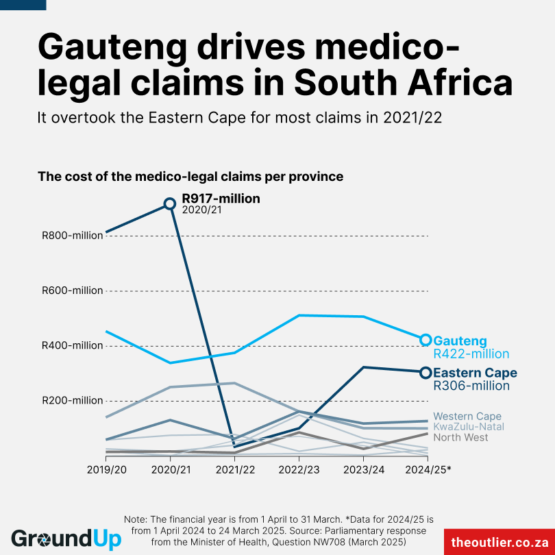
The majority of claims arise from obstetric injuries, including cerebral palsy, orthopedic surgeries, and trauma-related incidents.
ADVERTISEMENT
CONTINUE READING BELOW
Between 2014 and the early 2020s, negligence claims against the state surged. By March 2020, the cumulative value of claims (not payouts) reached 45% of the public health budget for that year, jeopardizing the ability of provincial health departments to deliver adequate care. However, after a rigorous effort by the state, both the number of negligence claims and the payouts associated with them have seen a sharp decline.
According to the National Treasury, payouts for negligence claims fell from R1.8 billion in 2019/20 to R1.5 billion in 2023/24. In 2024/5, the government disbursed R1.1 billion in negligence claims, as noted by Health Minister Dr. Aaron Motsoaledi in response to a parliamentary question last March.
While actual payouts are decreasing due to the state’s success in contesting claims, the overall value of claims remains exceedingly high. Only a small fraction of claims are fully paid out; many are reduced at the time of settlement, and a significant number lack a realistic chance of success. The legal process for claims can take years, resulting in substantial legal costs for both claimants and the state.
The state must still consider the possibility of successful claims and account for them accordingly. As of March 31, 2024, this “contingent liability” stands at R62 billion—over 20% of the public health budget.
A recent ruling by the Supreme Court of Appeal (SCA) determined that damages for future medical expenses must be paid as a lump sum, rejecting an alternative proposed by the Eastern Cape health department to provide ongoing treatment instead, often referred to as a “voucher system.”
This case involved a child born in 2011 who experienced severe disabilities due to negligence during birth. The Eastern Cape MEC for Health argued that the child could receive treatment at a lower cost within the public health system, asserting that large lump-sum payouts were unsustainably pressuring provincial budgets.
The high court in Bhisho initially agreed with this stance, ordering the department to provide treatment instead of paying damages. However, the SCA reversed this ruling.
ADVERTISEMENT:
CONTINUE READING BELOW
Read:
The private healthcare system is ‘unsustainable’ and increasing unnecessary hospital costs
Motsoaledi laments funding issues that hinder hiring more doctors
The specialist crisis in SA: Understanding why junior doctors are opting for unpaid positions
In a unanimous verdict, the SCA upheld the traditional “once and for all” principle, which mandates that damages, both past and future, are to be settled in a single lump sum.
In an expert witness opinion presented to the court on behalf of the department, economist Andrew Donaldson cautioned that the rising number of medical negligence claims poses a risk to the state’s capacity to enhance health service delivery. He noted that the annual growth rate of claims against state health departments is already outpacing the real (post-inflation) increase in resources available for health services, and could soon surpass even the nominal annual growth in resources.
Zeenat Emmamally, a legal researcher at the Helen Suzman Foundation, stated in a paper on provincial departments’ liabilities that “large compensation awards can’t be accurately budgeted as they are unpredictable and case-specific, forcing health departments to scramble to reallocate funds from their budgets to cover these claims.”
This diversion of funds hampers the delivery of healthcare services, leading to persistent underfunding of facilities that can result in even more medical negligence claims.
Donaldson proposed during the SCA case that a structure where costs are covered as they arise would align better with public finance management and address the challenges of forecasting future needs.
ADVERTISEMENT:
CONTINUE READING BELOW
He suggested this approach would synchronize the court system with budgetary and fund allocation processes, allowing the state to better match actual expenditures to needs and adjust those commitments over time as necessary. Implementing a pay-as-you-go approach could encourage faster settlements of claims, he noted.
Disbursing claims over time rather than as a lump sum could better protect the state’s service delivery capabilities amid existing financial constraints and escalating medico-legal costs, he argued.
While upfront settlements may still be suitable in certain situations, a flexible, needs-based approach could help balance compensatory obligations with the state’s broader service delivery responsibilities, according to Donaldson.
However, Justice Ashton Schippers, writing for the SCA, cautioned against “drastically” altering established legal principles, asserting that any such reforms should be left to legislative bodies.
The court also concluded that moving away from lump sum payments would generate uncertainty for patients and risk exposing them to inadequate care within a public system that has already let them down.
© 2026 GroundUp. This article was first published here.