

Hantavirus Patients Arrive in the Netherlands as Ship Continues Its Journey
A cruise ship linked to a deadly hantavirus outbreak is en route to Spain’s Canary Islands after evacuating three individuals, with two already reaching the Netherlands for medical care, according to its operator.
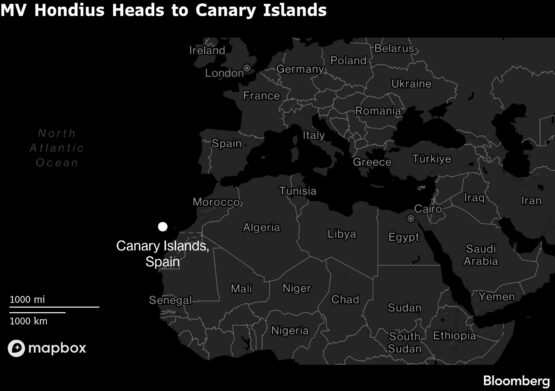
The vessel, the Dutch-flagged Hondius, departed Cape Verde on Wednesday evening and is anticipated to arrive at the Canary Islands in roughly three to four days, as stated by Oceanwide Expeditions BV, its operator. An aircraft meant to transport the third evacuee has encountered delays, while three additional medical personnel have boarded the ship to assist with care during the journey.
Spanish Health Minister Mónica García informed reporters that the ship is likely to dock at the Granadilla de Abona port in Tenerife on Saturday, although regional officials have expressed concerns about the plan and its timing. The outbreak has prompted a coordinated cross-border response, with authorities working together on evacuations, screening, and repatriation across multiple countries.
“All passengers and crew remaining on the ship as of today are asymptomatic,” García stated. “Unless a medical issue prohibits it, all foreign passengers will be repatriated,” following a protocol established by the European Commission, with assistance from the World Health Organization. The 13 Spanish passengers and one crew member will be transferred to a military hospital in Madrid for quarantine.
The World Health Organization has recorded eight medical cases associated with the cruise — five suspected and three confirmed — including three fatalities. Passengers, crew, and expedition staff from 23 countries remain on the Hondius.
ADVERTISEMENT
CONTINUE READING BELOW
Hantavirus is an uncommon infection usually transmitted through contact with infected rodent droppings or inhaling contaminated dust. Symptoms may take weeks to manifest, and in severe instances, the illness can progress swiftly to respiratory failure, with fatality rates reaching nearly 50% in the Americas.
The first patient, a Dutch man, and his wife traveled in South America before boarding the ship in Argentina on April 1. Both have since passed away.
A patient who returned from the initial leg of the journey in late April is currently being treated at University Hospital Zurich after testing positive for the Andes variant of the virus, which has been associated with rare human-to-human transmission. The patient is in isolation, while his asymptomatic wife, who traveled with him, is self-isolating as a precaution.
ADVERTISEMENT:
CONTINUE READING BELOW
The National Institute for Communicable Diseases in South Africa, where one evacuated patient is in intensive care, has also identified the Andes variant. Health Minister Aaron Motsoaledi stated that South Africa has recorded 62 individuals associated with the outbreak, either arrivals in the country or local contacts. Of these, 42 have been traced so far, with no one diagnosed with the virus.
The Swiss government announced on Wednesday that the risk of contagion to the public is low and considers the likelihood of further cases in Switzerland to be minimal.
Investigators are actively working to determine how the virus spread, including whether infections occurred prior to boarding or through limited transmission among close contacts on board.
© 2026 Bloomberg