

China’s Competitive Advantage in Africa’s Auto Market Goes Beyond Price
The most challenging aspect of entering a new market is identifying a competitive edge that distinguishes you. In a crowded marketplace, this becomes the ultimate test for any business’s survival.
So, what’s the key? How do some companies break into new markets and become leaders in no time?
At the Beijing Auto Show, it became evident: the key to China’s expansion in Africa is its unique approach.
While numerous European and Western brands rely on their legacy and market presence, Chinese manufacturers have adopted a fundamental principle of consumer markets – they actively listen to customer feedback.
Chinese automotive firms show little tolerance for the politics of branding. Instead, they emphasize rapid iteration and learning. They are not immune to failures; rather, they act swiftly to address them.
This results in a market environment where new models are launched, improved, and replaced at a speed that traditional manufacturers often find difficult to match.
Shifting Market Requirements
The Beijing Auto Show revealed that Chinese brands are no longer merely alternatives.
They now position themselves as genuine competitors, showing the scale, confidence, and product diversity to support their claims. Brands like Jetour exemplify this transformation.

It was evident at the Beijing Auto Show that Chinese brands are now positioning as serious contenders. Image: Supplied
Jetour may not be the oldest, at just eight years old, but it is strategically focused. The company has pinpointed a specific market segment and built around it with precision.
From off-road capabilities to integrated lifestyle accessories, the emphasis has been on creating a product ecosystem that directly addresses distinct consumer needs.
This clarity in positioning is vital.
In many ways, South African consumers are not asking for complexity; they seek reliability, affordability, and comfort tailored to everyday demands.
In a market characterized by lengthy commutes, diverse terrains, and pressing household budgets, practicality often takes precedence over aspirations. Notably, affordability has gained increased importance in recent years.
Global economic pressures, along with fluctuations in energy markets, have made cost efficiency a priority for many consumers.
Vehicles that strike a balance between price and perceived quality are entering a market where demand is aligning with their value proposition.
However, mere affordability isn’t enough to build a brand; execution is crucial.
“When we started, even internally, there were doubts about how quickly we could grow,” says Ke Chuandeng, president of Jetour International.
“But as a team, we held strong beliefs – and today, that faith is reflected in the swift global development of our brand.”
This growth is not random. South Africa, in particular, has been approached with intention, reflecting its significance within the broader African strategy.
“South Africa is a crucial market for us – not merely on its own, but as a key part of our larger African strategy. We have taken a very purposeful approach to our market entry and growth.”
Localization
Central to this intentional strategy is localization. This commitment to localization is poised to transition from planning to action.
Jetour announced at the Beijing Auto Show that it intends to start local production of its T2 SUV in South Africa by 2027, signaling a deeper investment in the market.
While specifics regarding scale and structure are still unfolding, the intent is unmistakable.
This is not merely about exporting vehicles to South Africa – it’s about integrating into the country’s automotive landscape.
“South Africa marked our entry into right-hand drive markets, and that was a deliberate choice. For us, localization is not an afterthought; it’s fundamental to how we establish a brand in each market,” states Chuandeng.
In a market where local manufacturing holds both economic and political significance, this distinction is crucial. It positions Jetour not just as a player in the passenger vehicle sector, but as a contributor to the wider industrial value chain.
This perspective begins to clarify why certain brands are gaining traction more rapidly than others.
In this context, localization transcends vehicle configuration; it encompasses a comprehensive understanding of the market dynamics—from consumer behavior and infrastructure to dealer networks and after-sales services.
It necessitates a level of agility that goes beyond simply exporting a product, requiring adaptation for the local environment.
This is where partnerships become essential.
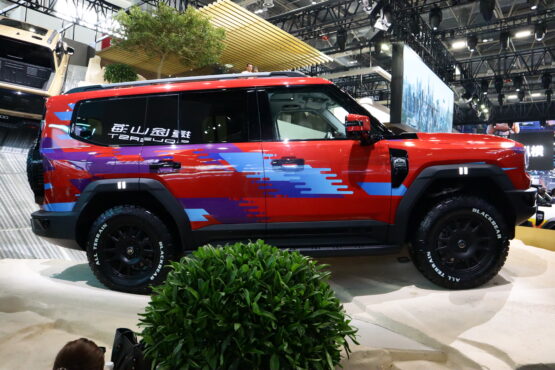
At just eight years old, Jetour may not be the oldest name, but it is definitely one of the most strategically focused. Image: Supplied
“Our success hinges on establishing strong partnerships with dealers, local stakeholders, and the government. This ecosystem is crucial for sustainable growth,” comments Chuandeng.
In a market like South Africa, where automotive industry dynamics significantly influence both economic output and job creation, this ecosystem is essential to the sector’s growth.
The question isn’t whether Chinese automakers are entering the market anymore—they already have. The pressing question is how deeply they plan to embed themselves, and initial signs indicate a long-term perspective.
Investments in dealer networks, growing emphasis on after-sales services, and a readiness to engage with local market intricacies all suggest a strategy that goes beyond mere short-term market share objectives.
However, trust remains a significant hurdle.
Cultivating Trust
For many South African consumers, especially in segments where reliability is paramount, trust is built gradually. It stems from ownership experiences—how vehicles perform under stress, the availability of parts, and the consistency of service quality.
This process cannot be rushed; however, it can be nurtured.
“When a new brand enters a market and gains partner confidence promptly, it’s significant. It signifies that the strategy is effective and that the long-term vision is credible,” states Chuandeng.
And this belief is continually being tested in real-time.
What we are witnessing is not just new entrants making headway, but a broader realignment of the automotive sector.
Chinese manufacturers are not merely competing on pricing.
They are competing based on responsiveness, product relevance, and their capacity to align with actual consumer needs—moving beyond traditional industry offerings.
“Our strategy in South Africa is clear. It revolves around delivering value, comprehending customer needs, and ensuring our products meet those expectations,” remarks Chuandeng.
The outcome is not dominance in a conventional sense. It represents a more structural shift—an evolution in market engagement, product development, and consumer prioritization.
“We always prioritize the customer. We aim to listen, adapt, and build a brand that caters to genuine needs in each market.”
And within this change lies the true answer. The secret isn’t merely about price or speed; it’s about alignment—between the product and the market, between strategy and execution.
Brought to you by Jetour.