
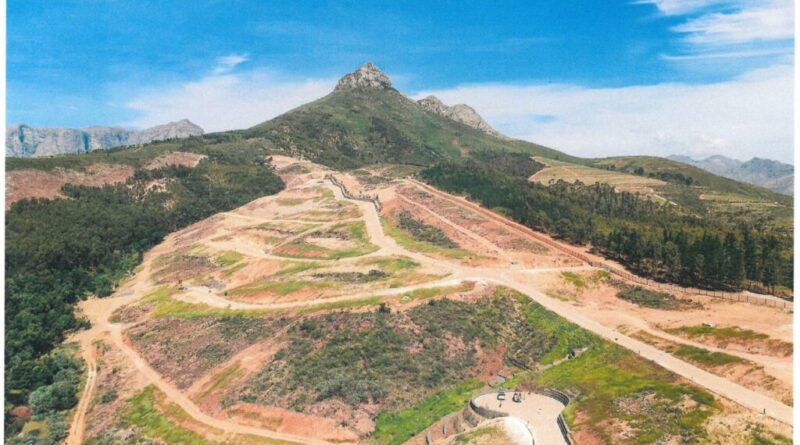
Legal Dispute Brewing Over Stellenbosch Luxury Estate
Several parties preparing for a significant legal confrontation regarding the contentious Botmaskop luxury residential estate near Stellenbosch are keeping their strategies under wraps. They have refrained from commenting on last week’s ruling by the Western Cape High Court, which issued an interim interdict halting construction of homes on the estate where some plots have been sold or provisionally sold for as much as R36.34 million.
ADVERTISEMENT
CONTINUE READING BELOW
Read: Battle over R300m Stellenbosch mountain estate
The interdict will remain effective until the case, which reviews several environmental authorizations, is fully resolved, potentially later this year.
However, one key stakeholder, Botmaskop Fynbos Estate, the property’s owner and the developer of the Fijnbosch Residential Estate (commonly referred to as Botmaskop), has taken a different approach.
Shortly after Judge Melanie Holderness issued her interdict ruling last week, Botmaskop enlisted the services of Dot Field Consultancy, a prominent public relations and corporate communications firm.
Less than a day later, a statement was released, quoting the developer as reaffirming its commitment to responsible development regarding the Botmaskop Estate project.
“While the company expressed disappointment regarding the ruling, it underscored its respect for the legal process and rule of law.
“The interim interdict was granted without prejudice, and the developer intends to present its complete position at the upcoming review hearing,” the statement indicated.
Concerned citizens
The application to the court has been initiated by the Stellenbosch Interest Group (SIG), a voluntary association of concerned locals established in 1996.
Part A sought an interim interdict, which has now been granted, while Part B will involve a thorough review of several environmental authorizations by the Western Cape government and Stellenbosch Municipality.
Among these, SIG is contesting an amended environmental authorization (EA) granted on February 18, 2021, by the case’s second respondent, the Director of Development Management in the Western Cape Department of Local Government, Environmental Affairs, and Development Planning.
In her ruling, Judge Holderness referred to this decision as “an inexplicable reversal of [the department’s] prior position.”
The political head of the department is MEC Anton Bredell, serving as the first respondent in the case.
The third respondent is the Stellenbosch Municipality, the local authority overseeing the property, whose controversial land swap with the developer is under scrutiny.
The Botmaskop Homeowners’ Association is the seventh respondent, while the registered owners of individual erven within the development are numbered among the eighth to thirty-second respondents. None of these parties opposed the Part A petition.
Bredell’s spokesperson Wouter Kriel stated that while the MEC acknowledged the judgment concerning Part A, he could not comment due to pending litigation.
Kriel noted that Bredell encourages all parties to expedite the court hearing.
ADVERTISEMENT:
CONTINUE READING BELOW
Stellenbosch Municipality communications manager Stuart Grobbelaar also declined to provide comments, stating that as the matter is currently in court and therefore sub judice, no comments could be made.
Johan van der Merwe, the SIG attorney, refrained from commenting on the case but outlined the forthcoming process. The initial step would involve finalizing the complete Record.
“It is a legal requirement that the decision-makers provide all pertinent documents related to the reviewed decisions. Here, the decision-makers are the province and the municipality.
“They have submitted some significant documents, but not all, so we are awaiting further materials.”
Once the record is complete, SIG, as the applicant, will have the chance to amend its founding affidavit, after which other parties may submit additional answering affidavits. This is primarily because previous affidavits mainly addressed the interdict (Part A of the petition).
“The judgment includes a provision allowing parties to seek ‘further directives to facilitate an expedited review’. Upon reaching that stage, we will have a clearer understanding of the timelines involved,” Van der Merwe stated.
Botmaskop’s statement was issued on behalf of the Staytus Collection, described on its website as “a boutique-style developer situated in the Western Cape” and part of the Rouxcor Group of Companies.
Botmaskop’s CEO Dr. Wouter Roux is identified as a founding partner and chief executive of the Staytus Collection, which includes Botmaskop in its portfolio. However, the name Staytus Collection does not appear in the court documents.
The statement cites Roux as asserting that Staytus “has fully complied with all statutory and regulatory obligations throughout the Botmaskop Estate Development.”
Before acquiring the property, Staytus conducted a comprehensive due diligence assessment to ensure the validity and security of all development rights and approvals. Plots within the Botmaskop Estate had been legally transferred to homeowners, with municipal approvals and registered title deeds obtained.
“We remain dedicated to protecting our investors’, homeowners’, and stakeholders’ interests, and to resolving this matter through the appropriate legal channels …
“As the fourth respondent, Staytus has consistently acted in accordance with sound corporate governance and the guidance of the Department of Environmental Affairs and Stellenbosch Municipality, remaining confident that the legal process will eventually corroborate its adherence to all regulatory and legal standards.”
© 2025 GroundUp. This article was first published here.
Follow Moneyweb’s in-depth finance and business news on WhatsApp here.