
Reaching the World Cup Could Cost You $250 for Parking or $30,000 for a Helicopter Ride
As millions of fans anticipate this year’s FIFA World Cup, many are experiencing sticker shock when it comes to ticket prices. Moreover, getting to the stadiums—particularly in U.S. cities—may turn out to be expensive, chaotic, or time-consuming, if not all three.
For those in New York and Boston with substantial funds, a helicopter ride that bypasses traffic gridlock is an option, costing up to $30,000 for a group of eight. More budget-friendly alternatives involve rental cars and Ubers, though these come with challenges such as surge pricing and excessive parking fees—$225, for instance, for a parking spot near New Jersey’s MetLife Stadium.
With only seven weeks to go before the matches commence across 11 U.S. cities and five additional locations in Canada and Mexico, many fans are still figuring out how to travel from their hotels to their seats, encountering new expenses as time progresses.
Some public transportation systems are increasing fares, while other stadiums will have limited public transit options or none at all.
Host cities are scrambling to fill the gaps, eager to avert a public disaster on a global stage with billions of dollars on the line. The World Cup is promoted as a once-in-a-generation economic boon and a chance to highlight America’s appeal to international tourists, in spite of backlash regarding President Donald Trump’s domestic and foreign policies, including the conflict in Iran. New York and New Jersey anticipate a $3.3 billion economic boost, with the total in the U.S. potentially reaching $30.5 billion, as per FIFA.
“It’s a significant challenge,” stated Paul Skoutelas, CEO of the American Public Transportation Association. Transit “agencies primarily focus on daily service, and now, on top of that, they must provide additional and extended services, including expansions to their fleets and service hours.”
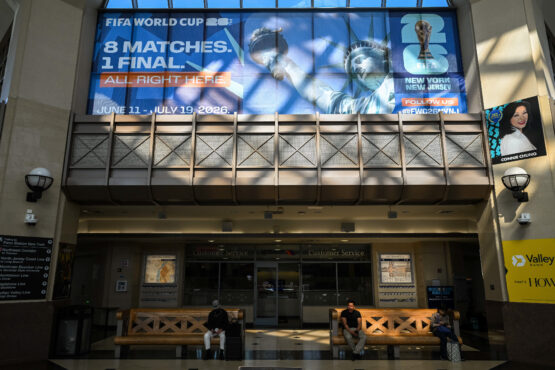
A banner for the FIFA World Cup at Secaucus Junction station in New Jersey, on April 17.
ADVERTISEMENT
CONTINUE READING BELOW
As the games approach, tensions are rising between New Jersey officials and FIFA regarding who should cover the additional transportation costs for fans. FIFA argues that agreements with host cities regarding costs and operations were established in 2023, clearly stating that FIFA would not bear these expenses.
New Jersey Governor Mikie Sherrill is challenging FIFA’s reluctance to contribute towards the costs, especially given forecasts of $11 billion in revenue from the tournament. MetLife Stadium in New Jersey’s Meadowlands is set to host eight games, including the championship.
Sherrill claims that these costs will compel New Jersey Transit to raise train fares for World Cup matches to a staggering $150 round trip, while special shuttle bus tickets will cost $80.
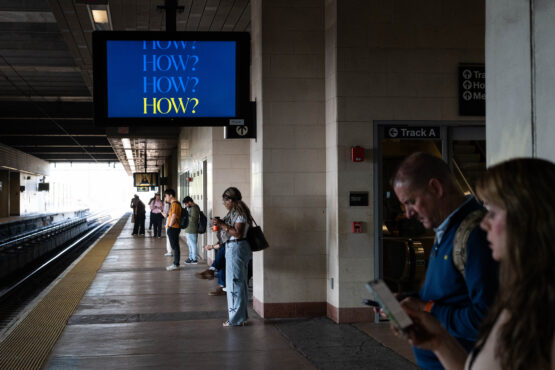
Commuters wait to board a New Jersey Transit train at Secaucus Junction station.
Demand on the system is expected to surge since there won’t be any parking at MetLife Stadium, where a limited number of spots are available at $225 in nearby lots.
“We are dedicated to ensuring that costs are shared fairly,” Sherrill stated. “We will not allow World Cup ticket holders to benefit at the expense of New Jersey residents who depend on NJ Transit daily.”
FIFA officials expressed their surprise when Sherrill suggested they assist with transportation costs. The existing agreement with host cities allows them to charge transit riders at cost, differing from an earlier agreement that mandated free transportation, as per FIFA’s statement.
ADVERTISEMENT:
CONTINUE READING BELOW
“To arbitrarily impose high prices and demand that FIFA absorb these costs is unprecedented,” said Heimo Schirgi, the COO for FIFA World Cup 2026. “No other global event, concert, or major sporting promoter has encountered such a demand.”
New Jersey is not alone in hiking transportation fares. The Massachusetts Bay Transportation Authority, which oversees Boston’s transit system, has started selling $80 round-trip train tickets to Gillette Stadium in Foxborough for World Cup events.
Fourteen trains will run for each World Cup match, up from the one or two typically scheduled for games involving the NFL’s New England Patriots. To enhance the stadium’s train station, the MBTA and state are investing around $35 million for upgrades, which includes new platforms to accommodate the influx of fans.
Even with optimized service, the trains can only cater to about a third of the spectators expected at the stadium, which holds 65,000. Most fans usually arrive at Gillette by car, but only about 5,000 parking spots will be available during the World Cup, a quarter of the normal capacity, to accommodate enhanced security measures and fan activities. Official parking passes range from $175 for opening-round games to $270 for a quarterfinal match.
On a national level, the federal government is allocating about $100 million for public transportation systems to handle World Cup-related expenses, including additional train and bus services and labor and security costs. However, Skoutelas indicated that this amount falls short of covering all extra services. The allocation of funds to host cities is determined based on stadium seating capacity and the number of matches in the region.
Since the pandemic, mass transit systems nationwide have struggled to enhance services and manage budgets, with ridership levels still lagging behind 2019 figures. Public transit providers heavily depend on additional revenue sources beyond fare collections, including state subsidies as well as revenues from tolls and sales taxes.
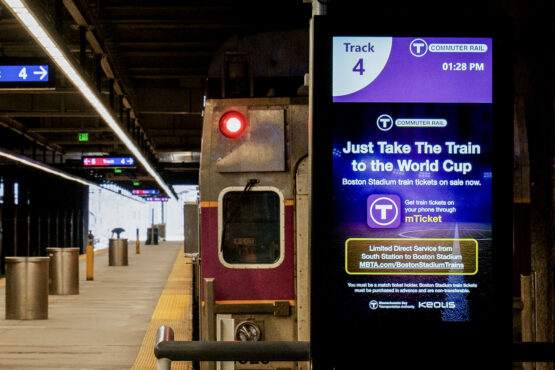
A sign promoting train tickets to Gillette Stadium for the World Cup at the South Station commuter rail station in Boston.
ADVERTISEMENT:
CONTINUE READING BELOW
In Los Angeles, budget-conscious attendees can avail themselves of $1.75 bus rides that commence service to the stadium four hours before the matches. Drivers should note that FIFA parking starts at $250.
Philadelphia’s transit system plans to offer free rides home after fans pay the typical $2.90 fare to reach their World Cup match, per the city’s host committee. Atlanta’s public transit will extend its service hours and provide staff to assist fans, while Houston plans to operate extra buses and trains to transport attendees to the stadium.
In the New York City area, Wings Air Helicopters will offer a service between Manhattan and Teterboro Airport in New Jersey, starting at $6,000 for a round trip with accommodation for five or six passengers, plus any additional event fees imposed by the airport. From Teterboro, it’s about a 4-mile drive to MetLife Stadium, and private car services can be arranged. Blade Air Mobility helicopter flights between Manhattan and Teterboro will kick off at $5,700 for a round trip.
In Boston, most helicopters can only get as close as a small airport in Norwood, approximately nine miles from the venue. From there, customers can arrange for a black-car service to the game, but they will encounter the same traffic congestion as everyone else approaching Gillette Stadium.
Blue Hill Helicopters is offering private round-trip flights between Boston’s Logan International Airport and Norwood, taking about five minutes, for up to $29,999 for a group of eight. Blue Hill’s chief pilot, Braveen Mahendran, mentioned a growing demand for these services.
“We’ve already received a few bookings,” Mahendran said, “but I anticipate many more.”
© 2026 Bloomberg